Humidity Is Coming: What Most People Get Wrong About Frizz Control
Late July, the walk from the office to lunch is long enough to undo forty minutes of work. The hair looked considered in the mirror. Three blocks later, it reads differently — bigger, softer at the edges, less like a decision and more like weather.
Nothing has gone wrong. This is what hair does in August, and the air is doing most of the work.
The problem is not the frizz. The problem is what people do about it.
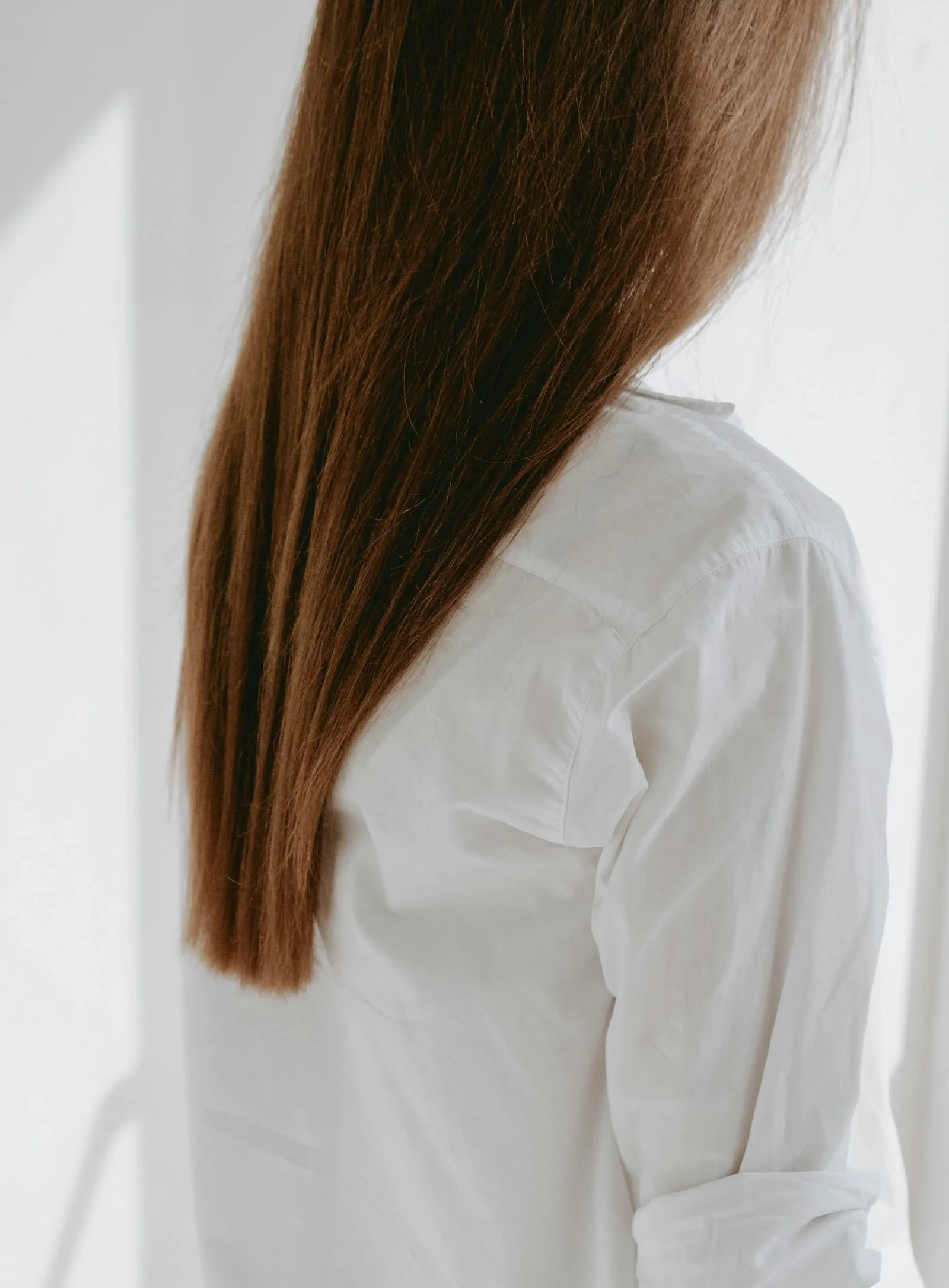
Control isn't the absence of movement. It's the absence of the fight.
What Humidity Actually Does
Hair is hygroscopic. The fiber absorbs moisture from the air — not as a malfunction, but as a structural property of the strand. When humidity rises, the cuticle scales lift slightly as the cortex swells with atmospheric moisture. The result is visible: increased volume, loss of surface smoothness, and the particular kind of unpredictability that makes New York summers difficult for anyone managing hair that was cooperative in April.
This is not a styling problem. It is a fiber problem. Products applied to the surface — serums, sprays, creams — can slow the process. They cannot stop it. The cuticle will lift. The cortex will swell. The hair will respond to the environment it lives in.
What most people get wrong is treating humidity as something to fight at the surface level, with more product, more heat, more effort. The fight itself becomes the problem. Hair styled aggressively against its natural response to moisture takes more time, requires more maintenance, and still loses by August. The result is not controlled. It is a daily negotiation that increasingly favors the weather.
What Humidity Does to Color
Frizz is the visible half of what humidity does. The other half happens to tone, and it is quieter.
Moisture moves into the cortex, and the strand swells. A swollen strand holds a lifted cuticle, and a lifted cuticle scatters light instead of returning it. The pigment has not changed. What has changed is the surface delivering it to the eye — so color that reads as deliberate in March reads as dull and slightly muddied in July, and the client reasonably concludes the color has faded.
It usually has not. It has stopped reflecting properly.
The second effect is real fading rather than apparent fading. A cuticle held open by humidity releases pigment during every wash. Tonal molecules are the smallest and the first to go, which is why cool tones drift first and warmth surfaces underneath. Summer does not so much fade color as accelerate the order in which it leaves.
Where the Season Hits Hardest: Gray
Gray hair takes this worse than pigmented hair, for structural reasons.
Gray strands are more porous and often coarser, with a cuticle that sits less flat to begin with. Humidity exaggerates a texture difference that was already there, so a blended gray that reads as integrated in cool weather can appear to separate visually in August — the gray lifting away from the surrounding tone rather than sitting inside it.
This is why gray blending has a seasonal dimension that flat coverage does not. Coverage either holds or grows out. Blending depends on the two textures remaining legible as one, and humidity is the condition most likely to disrupt that agreement.
What Keratin Actually Addresses
A keratin smoothing treatment works differently from a styling product because it works at a different level. Rather than coating the surface, it introduces a protein complex into the hair's outer structure. It seals it flat under heat — creating a smoother, better-aligned cuticle that is less reactive to changes in atmospheric moisture.
The hair continues to absorb water. What changes is the rate and degree of absorption, and the way the cuticle responds when it does occur. Hair that has been treated with keratin behaves more consistently across weather conditions because its surface is more stable. It moves in humidity without the expansion that produces frizz. It dries faster. It responds to styling more predictably. And it requires significantly less effort to maintain throughout the week.
This matters beyond texture. Smooth cuticle alignment directly affects how color reads — the dimensional quality of balayage, the precision of a tonal gloss, the warmth of a brunette result. Color applied to rough, porous hair behaves differently than color applied to smooth, sealed hair. A keratin treatment before summer, timed correctly relative to color services, supports both texture and color during the months when both are under the most environmental pressure. What that treatment actually does, and who it suits, is the subject of Keratin Smoothing Treatments in NYC: A Modern, Wearable Approach.
The Overcorrection Problem
The most common mistake with keratin is not using it — it is using the wrong version or applying it with the wrong expectations.
Not every smoothing treatment is the same. Formulas vary significantly in strength, protein concentration, and the degree of behavioral change they produce. A treatment designed to eliminate curl will produce a different result — and a different set of limitations — than one designed to reduce frizz while preserving natural movement. For clients with fine hair, the wrong formula can reduce volume to the point that it feels worse than the frizz it replaced. For clients with naturally straight hair and low porosity, the benefit may not justify the commitment.
The question is never whether keratin is the right tool in general. It is whether it is the right tool for this client's hair, at this point in their color history, with this degree of humidity exposure, and these lifestyle priorities. That specificity is what makes the difference between a treatment that transforms the summer experience and one that solves one problem while creating another.
For clients managing gray blending, this conversation is particularly relevant. Gray hair — structurally more porous and more reactive to humidity than pigmented hair — benefits significantly from cuticle support in warm months. A smoothing treatment in late spring can be the difference between gray blending that reads as intentional and sophisticated and gray blending that reads as unkempt because texture has overwhelmed the color design.
Control Without the Fight
The clients who manage summer most successfully are not the ones who fight the humidity hardest. They are the ones who stopped fighting it.
Not by giving up — by building a different relationship with what the hair actually is and what the environment actually demands. Keratin is a structural decision rather than a reactive one. Color is designed for how it will age through warm months, not just how it looks in May. A home care protocol that works with the fiber rather than against it.
Summer in New York is not a problem to solve. It is a condition to design around. And hair designed for that condition — smoothed, toned, protected, understood — does not fight the weather. It simply moves through it.
Photo by Liubov Ilchuk on Unsplash
Effortless Color For The Real You.