Keratin Treatments in NYC: How Humidity Changes the Way Your Hair Color Behaves
Spring arrives in New York in layers — first in the light, then in the air, and eventually in the humidity. For most clients, the texture shift that accompanies April is the most familiar seasonal disruption: hair that behaved predictably in February begins to expand, lose definition, and move differently in the damp spring air. What is less commonly understood is that humidity not only changes how hair feels, but also how it behaves. It changes how color looks.
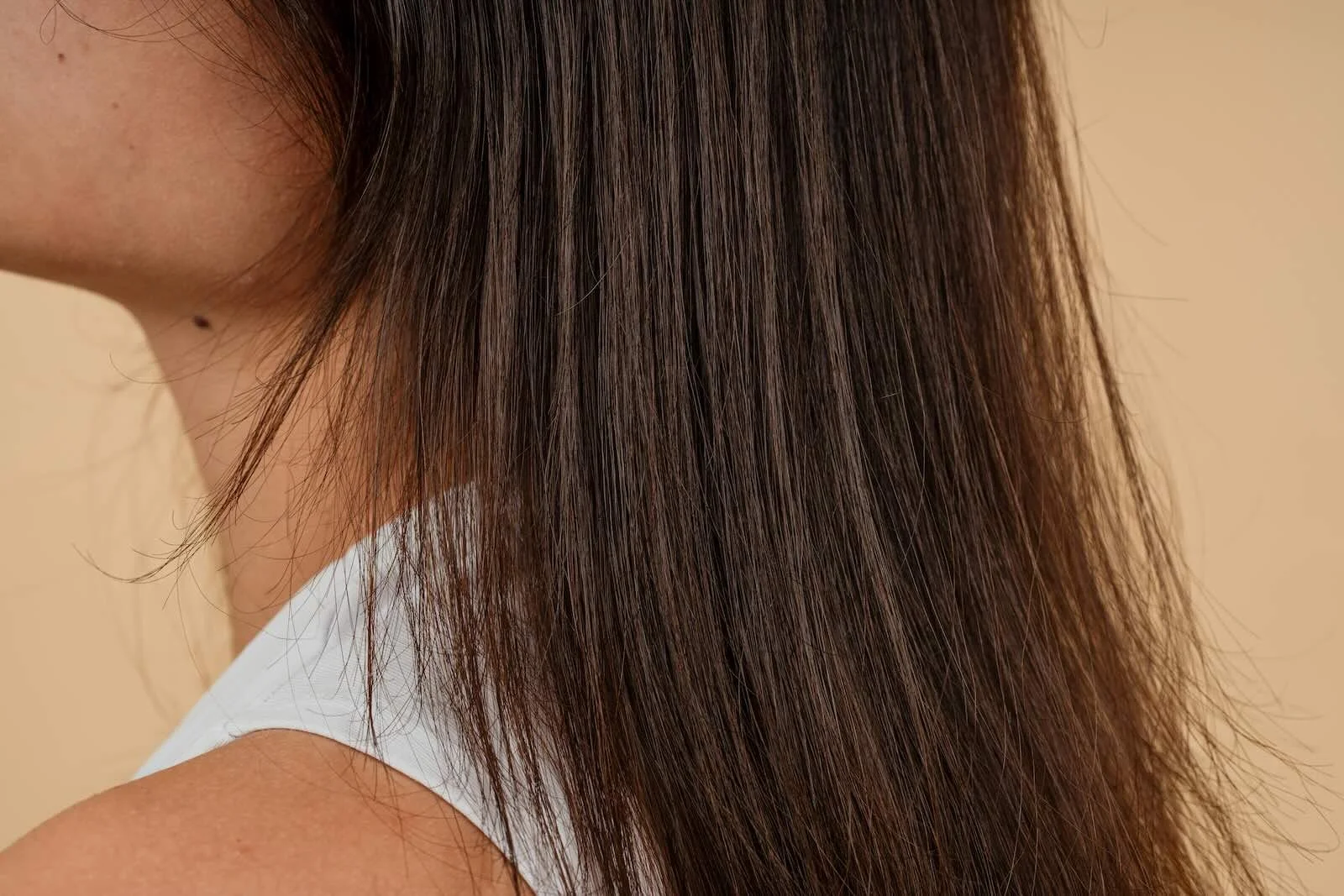
Smooth, reflective hair after a keratin treatment — helping control texture and humidity while enhancing the appearance of color.
What Humidity Actually Does to the Hair Fiber
Hair is hygroscopic — meaning the fiber readily absorbs moisture from the surrounding atmosphere. In dry winter air, the cuticle lies relatively flat, which is why color looks crisp, tones read accurately, and shine is easier to achieve and maintain. When humidity rises, the hair shaft absorbs water from the air, causing the cuticle scales to lift slightly and the cortex to swell. The result is visible: an increase in volume, a loss of smoothness, and — critically for color-treated clients — a change in how light interacts with the hair surface.
Raised cuticle scales scatter light rather than reflecting it. This is the physical reason that color appears duller, flatter, and less dimensional on humid days. It is not that the pigment has changed. The surface that delivers the pigment has changed. Color in any season is only as good as the condition of the fiber carrying it, and spring humidity, in a city like New York, puts that condition under real stress.
How Keratin Addresses the Root Problem
A keratin smoothing treatment works by introducing a protein complex into the hair's outer structure and then sealing it flat under heat. The result is a smoother, better-aligned cuticle that is less reactive to changes in atmospheric moisture. The hair does not stop absorbing water entirely — that is not biologically possible — but the rate and degree of absorption are reduced significantly. Hair that has been treated with keratin behaves more consistently across weather conditions because its surface is more stable.
This matters for color in a specific and practical way. When the cuticle is smoother, tones read more accurately. The warm honey that looked precise at the end of a spring appointment continues to look that way two weeks later, even when the humidity climbs. The dimensional quality of balayage — the movement between light and depth that makes the technique worth investing in — remains visible instead of being flattened by a roughened surface. The color does not need to be redone more frequently. It simply needs a stable surface to perform on. Read: Keratin Smoothing Treatments in NYC: A Modern, Wearable Approach
The Color-Texture Connection Most Clients Miss
There is a common pattern in spring consultations: a client returns for a color touch-up and reports that their hair has been looking flat or dull, that it is not behaving as it did after the last appointment, and that the color does not look as good as it did in the salon. In most cases, the formula has not failed. The surface has degraded.
This is the color-texture connection that most clients are not aware of — that the two are not independent variables. A formula designed for smooth, well-conditioned hair will read differently when that same hair has been roughened by weeks of humidity exposure, aggressive washing, or heat without protection. Understanding this shifts the conversation from "my color is fading" to "my color needs a better foundation to perform on."
The most effective way to address this is not always a new color appointment. Sometimes it is a keratin treatment, a bonding treatment, or a targeted conditioning protocol that restores the cuticle's integrity before the next color service. Color layered on top of compromised fiber will always underperform, regardless of how precise the formula is.
Not Every Client Needs Smoothing — But Every Client Needs the Conversation
Keratin treatments are not the right answer for every client. For someone with very fine hair, a full smoothing treatment can reduce volume to a degree that feels unwelcome. For a client with naturally straight hair and low porosity, the benefit may not justify the commitment. The question is never "should everyone get a keratin?" It is "what does this client's hair need to support the color work we are doing together, and how does humidity factor into that?"
For clients managing gray blending, this conversation becomes particularly relevant. Gray hair — especially naturally coarser, more porous gray — is more susceptible to humidity-related texture change than pigmented hair. A smoothing treatment in early spring can make the difference between gray blending that reads as sophisticated and intentional and gray blending that looks unkempt because the texture has overwhelmed the color design. Read: Gray Blending in NYC: Natural Coverage Without Harsh Regrowth
The Support Layer for Color in Humid Conditions
At-home product protocol matters more in spring and summer than at any other time of year. The Support layer for clients navigating the humidity season includes Redken Acidic Bonding Concentrate Shampoo and Conditioner, which help maintain the hair's acidic pH and keep the cuticle sealed between appointments. Living Proof Perfect Hair Day Dry Shampoo reduces the frequency of washing — every wash cycle opens the cuticle and accelerates color fade — while keeping hair manageable on humid days. And Moroccanoil Frizz Control, applied through damp hair before heat styling, provides a barrier that slows moisture absorption and preserves the smoothness that makes color read correctly.
These are not luxury additions. They are the practical infrastructure that determines whether color lasts eight weeks or four. The quality of what happens between appointments is as important as the quality of the appointment itself.
The Longer Logic: Color Designed for the Environment It Lives In
The most durable color work is always designed with the client's actual environment in mind — not just the tone and technique, but also the humidity, lifestyle, wash frequency, and product protocol that will carry the result through the weeks between visits. In New York, that means accounting for spring humidity as a real variable in the design conversation, not something to manage after the fact.
Color that looks exactly right in the salon but changes behavior the moment the client walks back into the city is not fully designed. The goal is a color that holds its integrity in real life — including the specific, persistent humidity that New York brings every spring and summer.
Why This Matters More Than Most Clients Expect
Humidity is often treated as a styling problem — something to manage with products after the fact. In reality, it is a structural variable that influences how the hair behaves at every level, from texture to light reflection to color perception. Ignoring it results in a color that appears inconsistent, even when the formula is correct.
When humidity is accounted for in the design phase — through texture management, smoothing strategies, and realistic maintenance planning — the result is not just better behavior, but better-looking color. The same tone reads more clearly, the same dimension stays visible, and the hair maintains its intended finish across different environments.
This is the difference between salon color and real-life color.
Effortless Color For The Real You.