Most women asking about gray blending aren't actually asking about gray. They're asking about the line. The hard edge where regrowth begins and color ends — the boundary that, week by week, makes every touch-up feel overdue. They've been managing that line for years. What they want is to stop managing it.
Gray blending is the answer to that problem. Most women don't want less gray. They want less evidence of it.
But here's what many don’t realize: "gray blending" describes that result—not a single way to get there. It's a real, useful term. It just isn't a technique.
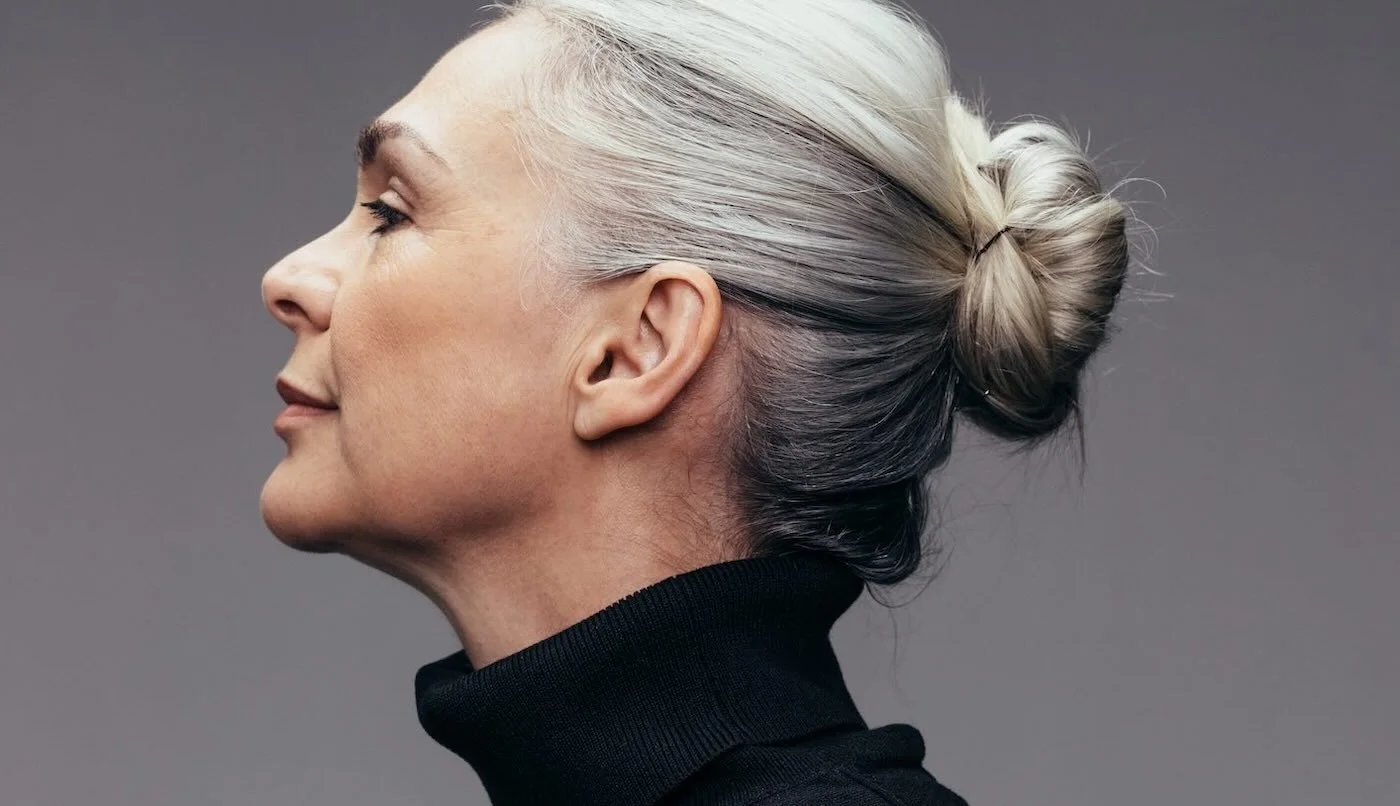
Natural gray with soft dimensional color — confident, balanced, and styled with intention.
What Is Gray Blending?
Gray blending is a color approach that softens the contrast between natural gray and colored hair, so regrowth reads as a gradient instead of a line. It is not about covering every silver strand. It's about reducing contrast — softening the point where natural growth meets previously colored hair so the result feels dimensional, flexible, and easy to live with.
Traditional gray coverage deposits a solid, uniform base at the root. The result is opacity: gray disappears completely, only to grow back. When it does grow back, it comes back all at once as a visible, high-contrast line that announces exactly how many weeks it's been since the last color.
Gray blending takes a different architectural approach. Instead of a single formula applied solidly, it uses tonal variation and strategic placement to break down the transition zone. Pigment diffuses rather than packs in. The boundary between natural and colored hair becomes a gradient, not a wall.
That shift changes everything about how the grow-out behaves. When color is engineered with built-in softness, regrowth becomes gradual rather than abrupt. There's no sudden announcement. There's just hair that still looks intentional, still looks designed — even eight or ten weeks out.
This is the same principle behind Balayage in NYC: Effortless, Lived-In Hair Color by a Master Colorist, where softness and a natural grow-out are built into the technique from the first application.
Is Gray Blending a Single Technique?
No — gray blending is a category of approaches, not a single named technique, and that's what gets lost when it is treated as one service. The right approach depends on the hair itself: density, growth pattern, how much gray is present, and texture all change it. Fine hair with concentrated gray at the temples needs a different placement strategy than coarser hair with evenly distributed gray. Both are accurately described as gray blending. Neither is interchangeable with the other.
This is also where the terminology gets genuinely confusing, because some gray blending approaches have brand names of their own. French blending, for instance, is L'Oréal Professionnel's trademarked protocol, a defined technique with its own formulation system, distinct from the broader category of gray-blending approaches. If you've encountered both terms and aren't sure how they relate, that's a reasonable point of confusion, and French Blending vs. Gray Blending: What They Cost, How Long They Take, and What You Should Know untangles it.
Not everyone is a candidate for gray blending in the first place — the same factors that determine technique also determine whether blending is the right approach at all, which is the subject of Who Gray Blending Is Not For — and What to Consider Instead.
Why Is Traditional Gray Coverage High-Maintenance?
Traditional gray coverage is high-maintenance because its uniform, opaque formula makes even a little regrowth read as a hard line. All-over color coverage does one thing very well: it erases gray completely. But the maintenance cost is high. Because the formula is uniform and the contrast is high, any visible regrowth looks neglected — even small amounts of growth can look like significant root exposure.
For many people, that means a root touch-up every four to six weeks. Not because the color is failing, but because the grow-out is unforgiving by design.
Gray blending redefines what maintenance means. It softens root lines, introduces tonal variation at the transition zone, and reduces the stark contrast that makes regrowth visible. The result isn't that you never need color again. It's that when you do, it happens on your schedule — not the color's. A four- to six-week cycle often stretches to eight to twelve weeks, or longer, which is the same logic behind Low-Maintenance Hair Color in NYC: What Actually Works for Busy Lives.
Is Gray Blending the Same as Going Gray?
No — gray blending keeps color in the picture while going gray lets it grow out entirely, and the distinction matters for anyone not ready to commit to a full transition.
Gray blending is not a surrender to gray. It's a strategy for living with it more gracefully. You keep the dimension. You keep warmth where you want it. You retain the ability to ease into lighter phases gradually, on your own timeline, without a dramatic in-between phase. For anyone considering the full transition, Going Gray Is a Decision. Here's How to Actually Make It. walks through what that process looks like, and Gray Hair: The Whole Conversation picks the subject up from there.
Who Benefits Most From Gray Blending?
Gray blending works best for hair that is roughly 30 to 70 percent gray, on anyone tired of rigid root cycles who wants softness and flexibility over solid, high-maintenance coverage. It's a category of approaches that rewards patience and penalizes urgency — meaning the less you chase maintenance, the better it tends to look, regardless of which specific technique you use to get there.
It's not right for everyone. Some people want full coverage, and that's a legitimate choice — Some People Want Coverage. That's Okay makes that case directly. Others are further along in a gray transition and need an entirely different approach.
How Does Maintenance Change After Gray Blending?
After gray blending, maintenance shifts from a fixed root cycle to occasional, targeted upkeep: a gloss refresh to restore tone and shine, a strategic adjustment for lightness to soften new growth, and, if needed, a seasonal correction for tonal balance.
This is a more nuanced relationship with color, one that accommodates real life rather than competing with it. What happens at home matters too, and How to Maintain Gray Hair After Blending (Without Purple Shampoo Overload) covers that side.
What Helps Gray-Blended Hair Last at Home?
Bond-supporting care, tone-correcting conditioners and gentle detangling are what help gray-blended hair hold its tone, shine and softness at home. Gray-blended hair tends to be healthier to begin with, because the technique requires less aggressive processing than full coverage.
The category that makes the most consistent difference is bond-supporting care. Olaplex Nº.0 Intensive Bond Building Treatment is among the most evidence-backed at-home options for strengthening chemically processed hair between appointments—apply to dry hair and leave on for ten minutes, not as a daily product, but as a weekly ritual. Color-depositing conditioners in ash or cool tones, such as Overtone and Celeb Luxury, are a useful option for clients managing warmth in blended gray between visits. A quality wide-tooth detangling comb also reduces mechanical breakage at the regrowth line, where hair is most vulnerable to stress.
These aren't a substitute for the color itself; they're what makes it last. For warmth specifically, Purple, Blue, or a Gloss: What Brassy Hair Is Actually Asking For sorts out which tool brassy hair needs.
What Does Gray Blending Actually Change?
Gray blending changes the question from how do I hide this to how do I design this. That's not a semantic difference — it changes the entire maintenance relationship.
When color is engineered with dimension and softness, regrowth becomes part of the design rather than evidence of neglect. That's what makes it sustainable. That's what makes it worth doing.
The American Academy of Dermatology notes that hair structure changes naturally with age, including shifts in texture, porosity, and pigmentation, all factors that affect how color takes and how long it holds. Understanding those changes is part of building a long-term color strategy, not just for the day of the appointment.
Gray blending is still useful shorthand for a real and common goal. It can't be a single fixed service, priced and described the same way for everyone who asks for it. The term describes where someone wants to end up; the technique that gets them there depends on the hair.
Great color should never feel overdone. It should feel like you.
Effortless Color For The Real You.