Who Gray Blending Is Not For — and What to Consider Instead
One of the more consistent moments in a consultation is when I have to tell someone that what they came in asking for isn't what they actually need. Clients often arrive with a clear idea of what they want, having researched and thought it through, maybe even showing me a photo. Saying "I don't think that's the right approach for your hair" requires more confidence in the result than the client currently has, and more honesty than most consultations are built around.
Gray blending is not a universal solution. The problem isn't the technique. It's the mismatch. It works exceptionally well for the right person. For the wrong candidate, it produces a result that looks neither like intentional color nor like natural gray — something in between that satisfies no one. The pattern below is one example: isolated, dense gray with nothing yet to blend into. Knowing who it isn't for is as important as knowing who it is for.
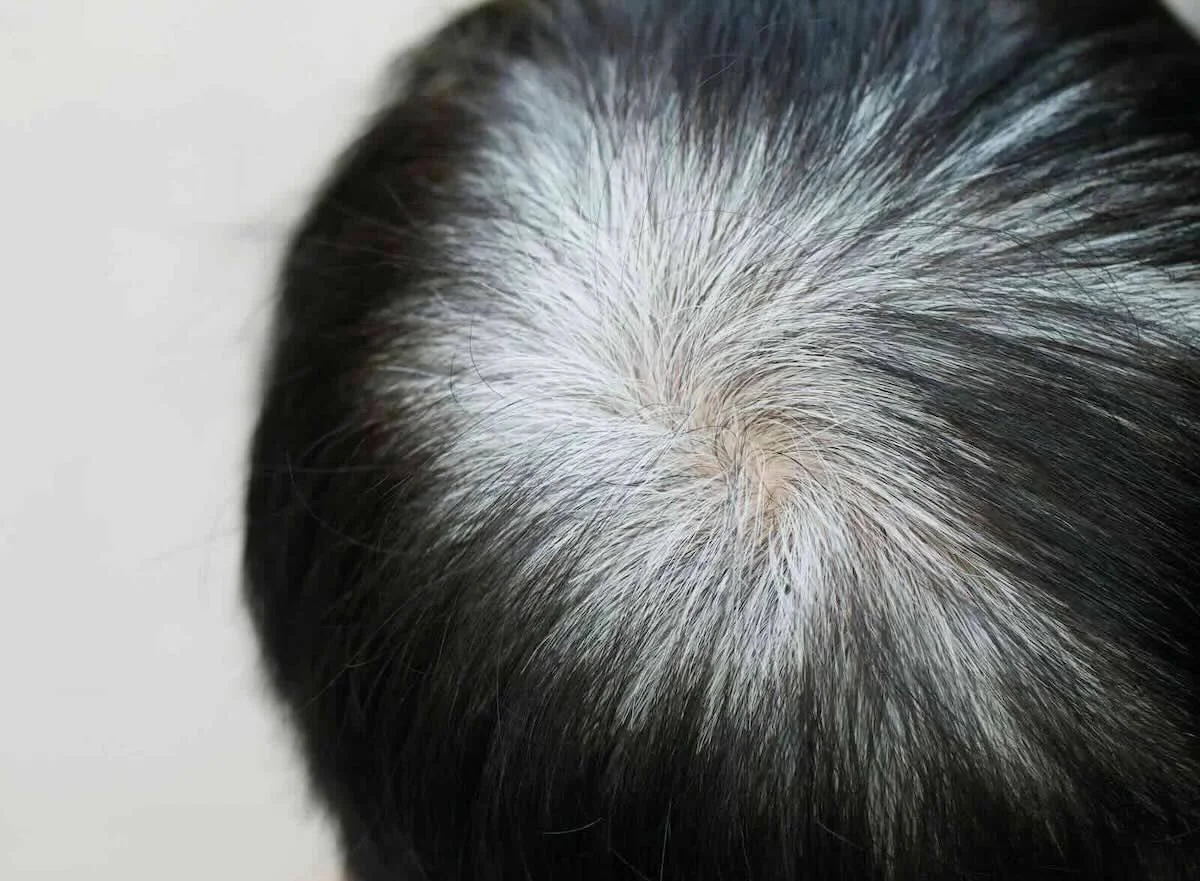
Not every gray pattern is ready to blend. Isolated, dense gray like this is one of the clearest signs to wait.
Clients Who Want Complete, Solid Coverage
Gray blending works by diffusing pigment rather than depositing it uniformly. That means the result, by design, still shows some gray — softened, integrated, dimensional, but present. The technique is built on the premise that well-handled visible gray is preferable to a maintenance cycle that demands constant correction.
If your goal is zero visible gray — a completely uniform, opaque root with no variation — blending is not the right tool. It is structurally incapable of producing that result because it is not designed to do so. A client who wants solid coverage and receives a blend will see the gray she was hoping to eliminate, even if it's been softened, and that visibility will feel like a failure rather than a feature.
The honest conversation here is about expectations. If the goal is elimination, traditional all-over coverage is the appropriate service. It comes with its own maintenance demands — root cycles every 4 to 6 weeks and a stronger chemical load on the hair — but it delivers the results it promises. Mismatching a client's actual goal with a technique that can't meet it is a more significant problem than recommending a higher-maintenance service.
For the full explanation of what gray blending actually produces and why it isn't a single technique:
What Gray Blending Actually Means — and Why the Term Gets Misunderstood
Clients With Very Low Gray Percentage
Gray blending works best when there is enough natural gray present to integrate into. The technique depends on the gray itself as a design material — the silver and white strands are what create the dimension and the soft, lived-in quality of a well-blended result.
Clients with very low gray percentages — roughly under 20 percent — often don't have enough gray distributed throughout the hair to blend naturally. The sparse, isolated gray strands read differently from distributed gray: they appear as individual anomalies rather than as a tonal layer that can be worked with. Blending at this stage often produces an uneven result rather than a dimensional one, because the base material isn't there yet.
For clients at this stage, selective highlighting or subtle low-maintenance color is typically a better fit. The goal is to create softness and dimension that echoes where the hair is going — without prematurely committing to a strategy the hair isn't ready to support yet.
Read: Low-Maintenance Hair Color in NYC
Clients Who Are Emotionally Attached to Solid Root Precision
This one is less about hair type and more about temperament, and it matters as much as any technical factor.
Gray blending, by design, reduces the urgency of root maintenance. The grow-out is intentionally soft — the point is that you don't need to come in on a rigid cycle because the regrowth is built to look gradual rather than obvious. For many clients, this is exactly what they want. For others, it produces a low-grade, persistent discomfort.
Some clients genuinely feel better when their roots are fresh and precise. That isn't vanity — it's a preference in how they move through the world, and it deserves to be respected rather than argued away.
For a client who checks her roots every morning and feels off when they're visible, a technique designed around accepting visible regrowth is a mismatch, regardless of how well executed it is. She'll feel behind even when the hair looks intentional to everyone else.
The consultation question I find most useful here isn't "how often do you want to come in?" It's "how do you feel between appointments?" A client who says, "Fine, I don't really think about it," is a candidate for blending. A client who says "I notice it immediately and it bothers me" may not be — at least not yet.
Clients Who Are Not Emotionally Ready for the Transition
Gray blending, when fully expressed, moves hair toward a more natural state. That's a gradual process, and it involves a period where the hair looks neither fully colored nor fully natural. Not every client is ready to move through that phase, and starting a blending strategy with someone who isn't psychologically prepared for the transition typically produces anxiety rather than relief.
The readiness question is worth asking directly. A client who comes in primarily because she's exhausted by the maintenance cycle but who hasn't yet made peace with looking different is in a different place than a client who has genuinely decided she wants to stop chasing coverage. The first client may be a blending candidate in six months. She may not be one today.
For the full account of what the transition phase actually involves:
The In-Between Phase: What Really Happens When You Stop Coloring Gray Hair
Clients With Heavily Accumulated Artificial Color
This is a technical candidacy issue rather than a preference issue. Clients who have been doing dark, opaque all-over color for many years — particularly with repeated applications of permanent, high-pigment formulas — often have significant color buildup along the length and mid-shaft. The hair has a heavy artificial base that is chemically difficult to soften or lighten without risking uneven processing, banding, or damage.
For these clients, blending is not impossible. Still, it requires a more complex preliminary process — sometimes multiple lightening sessions to remove enough accumulated pigment to achieve a natural-looking result. Moving directly to a blending strategy on heavily processed hair typically produces a muddy, uneven result that looks neither intentional nor natural.
The honest recommendation here is a slower plan: address the hair's structural condition first, work through the accumulated color gradually, and begin the blending strategy once the hair can support it.
How This Differs From French Blending Candidacy
It's worth being direct about something that often comes up: the candidacy questions above apply specifically to gray blending as a category. French Blending™, L'Oréal Professionnel's trademarked protocol, has its own candidacy considerations, and they aren't identical. French Blending™ is built around a more structured, higher-density approach designed for clients with significant gray coverage who want a defined, branded system rather than an umbrella category of techniques. A client who isn't a gray blending candidate for technical reasons — heavy color accumulation, for instance — usually isn't a French Blending™ candidate either, for the same underlying reason. But a client who wants more structure, a defined protocol, and a higher initial investment in exchange for a more comprehensive result may be a better fit for French Blending™ than for the broader gray blending category described here.
French Blending vs. Gray Blending: What They Cost, How Long They Take, and What You Should Know
What Supports Clients Who Aren't Blending Candidates Yet
Clients who fall outside blending candidacy for technical reasons — particularly those managing heavy color accumulation or very low gray percentage — often have hair that needs structural support before any significant color strategy is appropriate.
A consistent repair protocol using the Shu Uemura Art of Hair Ultimate Reset Extreme Repair Hair Mask weekly helps stabilize color-damaged hair and prepare it for future lightening, fortifying the fiber from root to tip without further stressing already compromised strands. A deeply moisturizing masque used weekly helps stabilize color-damaged hair and prepare it for future lightening, fortifying the fiber from root to tip without further stressing already compromised strands. The Kérastase Première Masque Filler Réparateur, used biweekly, addresses the porosity and calcium buildup that accumulate with long-term all-over color — rebuilding the hair's inner structure while the transition plan takes shape. And for clients waiting for their gray percentage to increase before beginning a blend, Pureology Hydrate Shampoo extends the life of their current service with a sulfate-free formula built specifically for color-treated hair.
These aren't consolation products. They're the preparation that makes the eventual transition possible.
The Goal: The Right Technique, Not the Popular One
The value of this conversation is not in talking clients out of something they want. It's in ensuring that what they pursue actually delivers what they came for. Gray blending is a powerful technique in the right context. In the wrong context, it produces a result that satisfies no one and damages the trust that makes long-term color work possible.
A colorist who tells you honestly that a technique isn't right for your hair is giving you more useful information than one who agrees with whatever you've walked in asking for. That honesty is the foundation of the relationship — and it's what makes the work that does happen more likely to succeed.
Not every technique is right for every person. That's not a limitation. It's precision.
Effortless Color For The Real You.