The In-Between Phase: What Really Happens When You Stop Coloring Gray Hair
The decision usually comes quietly. Not as a dramatic announcement, but as a slow accumulation of small frustrations — the appointment that came too soon again, the cycle most clients associate with traditional color. For a different approach, see low-maintenance hair color in NYC. The two weeks of visible roots that made you feel behind before anything else had changed. The sense that you were maintaining a version of yourself that no longer felt worth the upkeep.
At some point, the cost of staying the same becomes higher than the discomfort of change. That's when most women decide to stop. What they're usually not prepared for is what comes next.
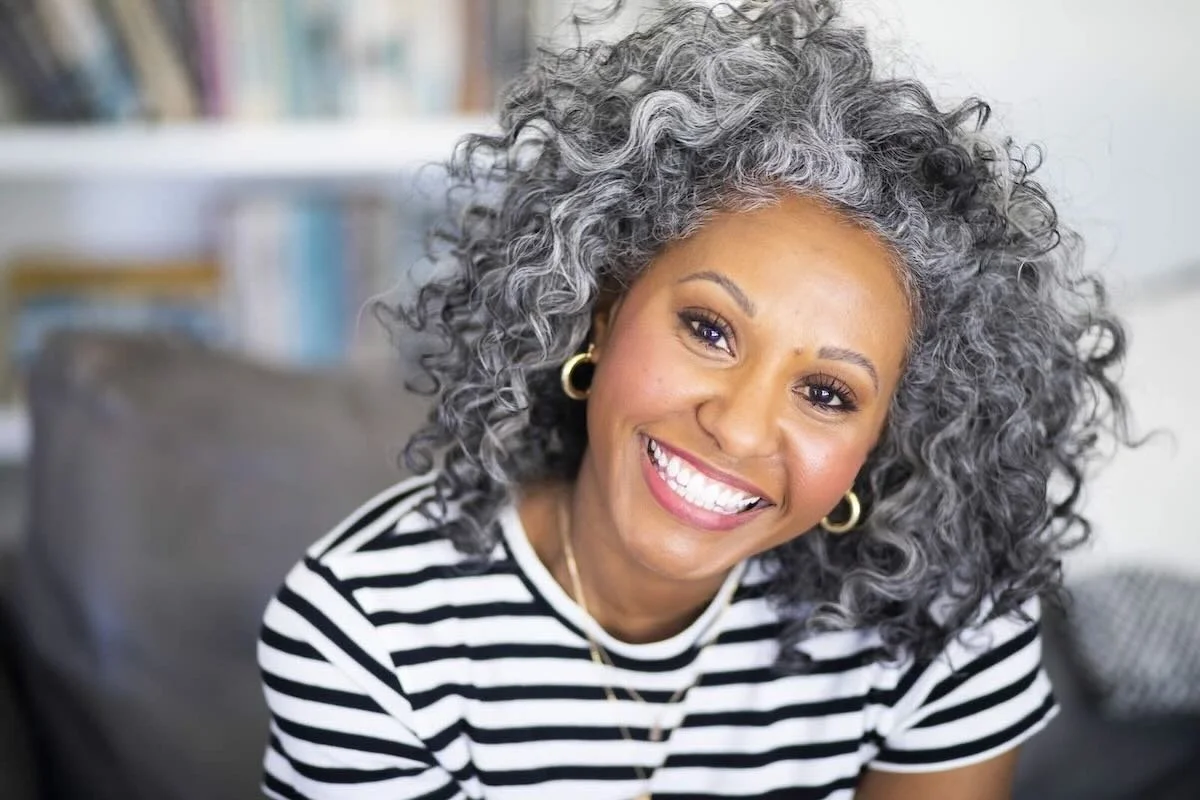
The in-between phase of gray transition requires patience, strategic blending, and realistic expectations.
What the In-Between Phase Actually Looks Like
When you stop solid gray coverage, the first thing that happens is a change in contrast. Natural regrowth becomes visible against previously colored hair — not just at the root, but along the length, where old color still holds warmth or pigment that the new growth doesn't share. Depending on how long you've been coloring and how much gray you actually have, that contrast can be subtle or stark. What it rarely is, at least at first, is seamless.
This is the part that surprises people. The decision to stop feels like a release. The reality of the transition feels like construction.
There are usually three things happening simultaneously: a visual adjustment as the two zones of hair learn to coexist, a textural shift as gray hair behaves differently than pigmented hair (more porous, more reflective, sometimes coarser at the strand level), and an emotional recalibration as you begin to measure what your hair looks like against a new standard instead of the old one.
None of these are problems. All of them take time.
For the foundational technique that makes this transition less visually abrupt:
What Gray Blending Actually Means — and Why the Term Gets Misunderstood
Why the Early Weeks Feel Uncomfortable
Uniform color coverage creates a kind of visual predictability. You know what your hair looks like. You know when it's "on" and when it needs attention. That system, for all its maintenance demands, is legible. There's a clear before-and-after for every appointment.
When you step away from that system, you lose the legibility — at least temporarily. The eye, which has been trained to read your hair in a particular way, now encounters a result that doesn't match its reference point. The hair looks unfinished. Inconsistent. Somewhere between two states.
This is not a failure of the transition. It is the transition.
The discomfort most clients describe in the first few months isn't really about the hair — it's about losing a clear signal. "Done" versus "needs work" was easy to read before. Now it requires a new framework. Building that framework takes longer than most people expect, and the timeline varies significantly depending on how much gray is present, the underlying pigment, and how the hair has been historically colored.
The most important thing to understand is that this phase has an end. It is not a permanent state.
Glamour calls this approach "quiet silver" — a low-key, gradual method that allows clients to move toward their natural gray without hard lines or the feeling of a dramatic before-and-after moment.
Blending vs. Stopping Abruptly
There is a meaningful difference between deciding not to color anymore and deliberately transitioning. Stopping abruptly — simply not making the next appointment — is a valid choice, but it produces the sharpest possible contrast line and the longest in-between phase. The new growth and the old color coexist without any mediation.
Strategic blending is a different approach. A colorist introduces tonal variation at the transition zone — not to maintain coverage, but to soften the line of demarcation. The gray and the remaining color are graduated rather than divided. The visual result is a more dimensional, more gradual transition that reads as intentional rather than interrupted.
For most clients, this is the more livable route. It extends the transition window, but significantly reduces the perceived difficulty in the early weeks.
For a step-by-step approach to planning a deliberate transition:
Going Gray Is a Decision. Here’s How to Actually Make It.
How Long the In-Between Phase Actually Takes
This is the question underneath every other question, so let me answer it as directly as the subject allows.
Hair grows about half an inch a month. That's the fixed part — no product or technique changes it. What changes is how the transition reads while that growth happens, and that depends on four things: how much gray you have, how dark your previous color was, whether you're blending or stopping cold, and how long your hair is. Old color doesn't fade away; it grows down and gets cut off. Length is the timeline.
The first three months are the steepest part. Contrast is at its highest, the eye hasn't adjusted, and the line — if you stopped cold — is at its most legible. This is where blending does its heaviest work, and where most clients who abandon the transition give up. If you make it through month three, you've done the hardest part.
Months four through eight are where things turn. The gray has enough territory to read as deliberate rather than overdue. Dimension starts doing what solid coverage never could. This is also when the textural differences show up in earnest, which is why the hydration and glossing work matters most in this window.
Months nine through eighteen are the long middle to the finish. Chin-length hair may be done by month nine or twelve. Shoulder-length hair carries its history longer — often for a year or more — with the last of the old color leaving through regular trims rather than any single dramatic cut.
I'd treat any timeline more precise than that with suspicion. A client with 60% gray and a soft brown history moves through this faster than a client with 20% gray and years of dark espresso color — that's not a matter of effort, just of contrast. What I can say with confidence after thirty-five years: the phase ends, it ends sooner when it's designed rather than endured, and almost no one who finishes wishes they'd waited longer to start.
Managing Tone and Texture During the Phase
Gray hair is structurally different from pigmented hair. The cortex — the layer that holds moisture and gives hair its elasticity — behaves differently without melanin. Gray strands tend to be more porous, which means they absorb product, humidity, and environmental tones more readily than pigmented strands. This is why gray hair can look dry, wiry, or off-tone even when it's been carefully maintained.
During the in-between phase, when gray and pigmented hair coexist along the same strand, these textural differences become more pronounced. Hydration is the highest-leverage variable. Hair that is well moisturized reads as softer, more cohesive, and more controlled — regardless of where it is in the transition.
Glossing treatments during this period serve double duty: they restore surface shine and deposit a small amount of neutral or cool tone that unifies the transition zone without adding significant coverage. Used occasionally rather than routinely, they help the hair look managed without prolonging the need for coloring.
A note on purple shampoo: it has its place, but overuse during a transition phase can create an artificial blue or lavender cast on gray, making it read as processed rather than natural. Restraint matters.
For practical home and salon guidance during the transition:
How to Maintain Gray Hair After Blending (Without Purple Shampoo Overload)
Not Everyone Should Go Cold Turkey
The decision between blending and abrupt stopping depends heavily on two factors: the percentage of gray and the existing color contrast. Clients with high gray percentage and naturally lighter pigment often have an easier transition — the contrast between old color and new growth is less dramatic, and the gray itself may be light enough to read as dimensional rather than stark.
Clients with darkly pigmented hair and a lower percentage of gray tend to have the hardest transitions when stopping cold. The contrast is high; the gray appears as a distinct white or silver against the dark color, and without strategic blending, there is no gradual gradient — only a line.
For a direct assessment of candidacy:
What Supports This Kind of Transition
The in-between phase asks more of your hair than most other periods. The strand carries two distinct chemical histories, two distinct moisture profiles, and potentially two distinct textures — all in the same length. What you use at home during this time matters more than usual.
Bond-supporting treatments strengthen the processed section of the hair while the natural gray grows in. The K18 Leave-In Molecular Repair Hair Mask, applied after shampooing in four minutes, is one of the most effective interventions — working at the molecular level to reconnect broken bonds in the processed section while the natural growth catches up. A deeply moisturizing masque applied at the mid-shaft and ends — where old color lives — helps equalize the porosity difference between the two zones. And lightweight, heat-protective serums used before styling help protect the transition zone from the mechanical stress of daily blow-drying, where most visible breakage occurs.
These aren't luxury additions during the in-between phase. They're structural maintenance.
The Emotional Architecture of the Transition
This is the part of the conversation that rarely happens in a consultation, but probably should. The in-between phase is not just a visual process — it's a psychological one. Hair color, for many women, is tied to a narrative about control: how you look at work, how you show up for events, how you feel when you catch your reflection unexpectedly. Stopping color doesn't just change how your hair looks; it also changes how it feels. The disorientation most clients feel in the early weeks is less about the hair and more about the absence of a familiar signal. When the hair looked "done," that was a form of certainty. The in-between phase removes that certainty temporarily — and for women who have been managing their color for decades, that absence is more jarring than it might seem from the outside.
What comes on the other side, for most clients who move through it with some deliberateness, is something quieter and more sustainable. A relationship with your hair built around acceptance and design rather than constant correction. You stop tracking regrowth. You stop feeling behind. You start making choices from a more settled place.
Hair is one of the most identity-linked aspects of physical appearance — I've seen that consistently across thirty-five years of consultations. Changes associated with aging carry significant emotional weight that deserves acknowledgment rather than dismissal. The in-between phase is hard, not because the hair looks bad, but because it requires updating a self-image that has been stable for a long time.
That update is worth it. It just takes longer than the Instagram version suggests.
Questions I Hear in the Chair
Can I speed it up?
You can compress the difficulty, not the biology. Growth stays at half an inch a month no matter what we do. What blending, glossing, and strategic lightening actually buy you is livability — the months pass either way, but they pass with hair that looks intentional instead of interrupted. The only true accelerator is scissors.
Should I cut my hair shorter?
Only if you want shorter hair, a shorter cut moves the finish line closer because the old color exits sooner — that's simple arithmetic. But I've walked plenty of clients through full transitions at shoulder length and beyond. It's an option worth considering, not a toll you have to pay.
Will my gray always feel like this texture?
Usually not. Gray hair is more porous than pigmented hair, and in the early months — while it shares a strand with chemically processed lengths — it tends to read wirier and drier than it actually is. Once the transition completes and your care routine catches up to what the hair now needs, most clients find the texture settles considerably. What you have at month four is not what you'll have at month fourteen.
Do I have to stop coloring completely?
No — and this is the most common misunderstanding I correct in consultation. Transitioning isn't a vow. Blending lets you keep warmth or dimension exactly where you want it, for as long as you want, while the gray integrates into your timeline. Some clients blend for a season and then let go entirely; some keep a little warmth indefinitely. Both are legitimate. The goal was never less color — it's less management.
Effortless Color For The Real You.