What I Notice About Hair in July That Has Nothing to Do With Color
The air at 14th Street was already heavy by mid-morning. The kind of July heat that settles into the subway before you even reach the platform — dense, close, the kind that makes everything feel slightly slower than it should. I was on the escalator heading up toward Union Square when I noticed the woman in front of me.
I never saw her face. I doubt she knew I was there. But I couldn't stop looking at her hair.
Platinum white, tightly coiled, full volume — the kind of hair that announces itself from across a room and holds the eye without asking for permission. In the gray institutional light of the subway station, against the heat rising off the concrete, it looked extraordinary. Not because of the color. Because of what it was doing.
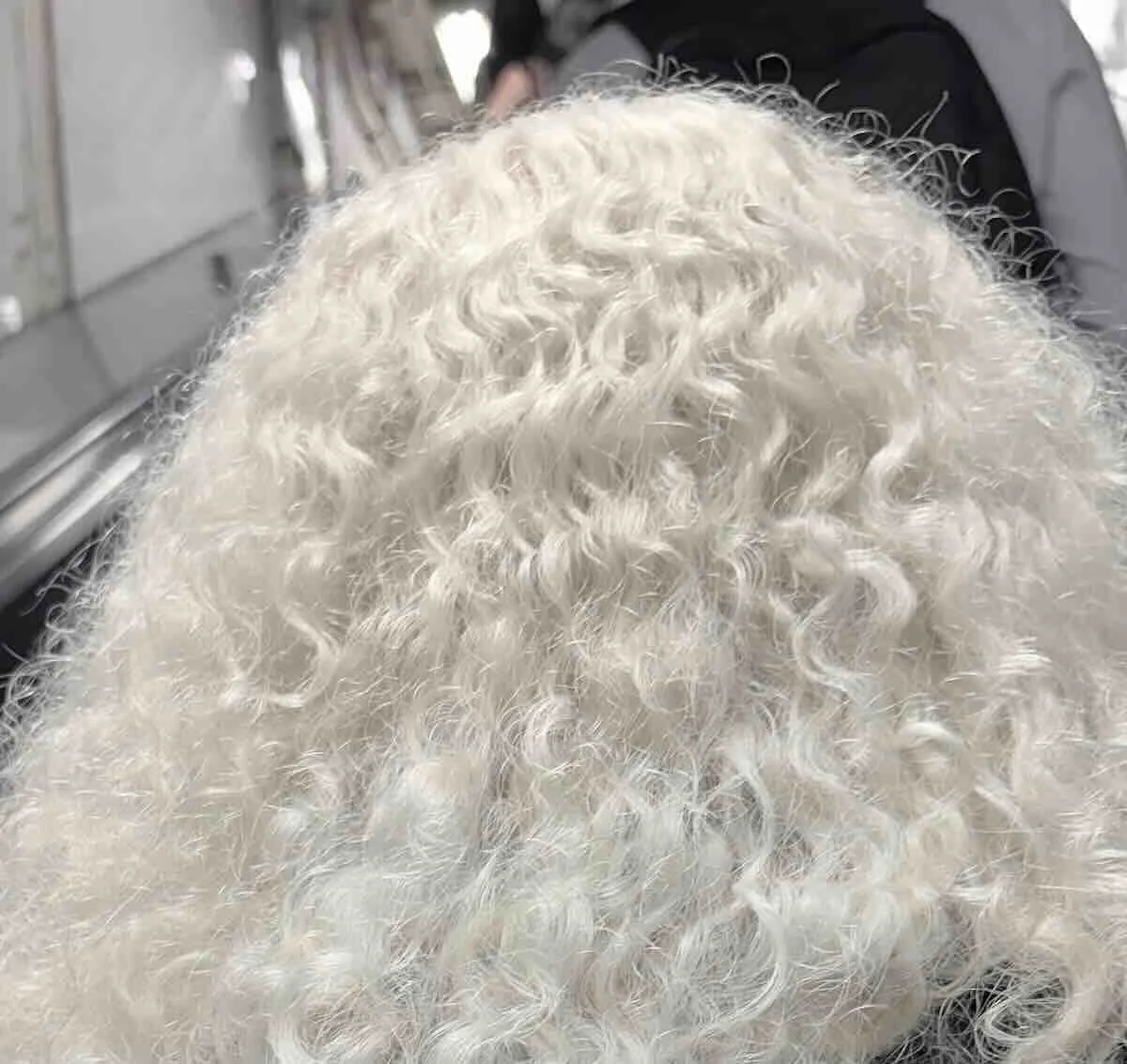
I never saw her face. I couldn't stop looking at her hair.
Why Does Natural White Hair Catch the Light?
Natural white hair catches the light because there is no pigment left in the strand to absorb it. On a coiled texture, it is one of the most visually striking combinations I encounter — and one of the most structurally demanding for the scalp to maintain. Hair that has lost its pigment has also lost melanin's protection — melanin absorbs ultraviolet light, so gray and white hair is more easily damaged by the sun, as the dermatologist Zoe Diana Draelos has written in the Journal of Cosmetic Dermatology. It becomes more porous, more reactive to humidity, more sensitive to what the season asks of it, which is part of the wider story in Gray Hair: The Whole Conversation. In certain light — and the flat gray light of a subway station is surprisingly good at this — it can crystallize. It catches and holds light in a way that colored hair doesn't. That's what I was looking at.
But I was also thinking about something else. Not what was happening to her hair right now, but what was already being decided, quietly, and wouldn't show up for months.
Why Is My Hair Falling Out in the Fall?
Hair that falls out in the fall usually started in the summer. A pattern shows up every year, and it has almost nothing to do with how your hair looks in July. It's what happens in September.
Hair doesn't shed the day something goes wrong. The follicle cycle has a built-in delay — stress or disruption to a follicle in early summer often doesn't show up as noticeable shedding until eight to twelve weeks later. That means what someone experiences as "my hair is suddenly falling out in the fall" is very rarely a fall problem. It's a summer bill arriving late. A 2009 study of 823 women published in Dermatology found the share of resting-phase hairs highest in summer — the hairs that fall in the autumn.
This is different from the everyday fading and dryness that comes up around this time of year. It's not about how the hair looks right now. It's about a decision the scalp made in July that nobody notices until October, because the gap between cause and effect is too wide for most people to connect on their own — which is the subject of Your Scalp in Summer: What's Actually Happening Up There.
Why Does Seasonal Hair Loss Catch People Off Guard?
Seasonal hair loss catches people off guard because nothing changed in the month they notice it. Most people who start worrying about shedding in September ask the same question: what changed? Usually, nothing changed in September. Something changed in July, and the hair is only now reporting it — the same September reading behind What Your Hair Tells Me in September.
The follicle doesn't respond instantly to a stressful few weeks — heat, dehydration, a summer illness, a period of poor sleep, or aggressive sun exposure without protection. It responds with a delay, much like a stressed plant might not show it for weeks. By the time the shedding is visible, the original cause is long past and easy to miss entirely.
This is part of why I find myself doing what I did on that escalator — watching something in real time and thinking less about the moment and more about where it's heading. Not because I'm trying to. Because thirty-five years of doing this makes it automatic.
What Helps Prevent Seasonal Hair Loss?
Seasonal hair loss is best prevented in summer, while the scalp is still under the stress that causes it. If the effect shows up in September, the only useful window is now — not as damage control, but as prevention timed to when it actually counts.
The COOLA Scalp & Hair Mist Organic Sunscreen SPF 30 protects the part line and scalp surface directly, which matters because UV exposure is one of the more common triggers for the kind of follicle stress that shows up months later. The Ordinary's Glycolic Acid 7% Exfoliating Toner, used on the scalp rather than just the face, clears the buildup that can compound follicle stress during the exact weeks that matter most. And the VEGAMOUR GRO Scalp Detoxifying Serum supports the follicle environment during the window that actually determines what November's hair will look like.
None of this is about panic. It's about paying attention when it happens, rather than reacting months later to an effect whose cause has already passed.
Why Is Scalp Care So Hard to Start Before Shedding?
Scalp care is hard to start before shedding because it asks someone to care about a problem that doesn't yet exist — the same gap behind What I Notice About Your Hair Before You'd Think to Ask.
The woman on the escalator disappeared into the crowd at Union Square. I don't know anything about her routine, her stress level, or what July is asking of her. But I know that whatever's happening to her scalp right now won't announce itself for another two months, and by then, most people won't think to connect it back to a Tuesday in July.
I'm not sure I'll ever stop doing that math automatically. I think that might be the job.
Effortless Color For The Real You.
albertcolor.com