A brush cleared on Sunday holds a small tangle of long dark strands by Wednesday. That is where most women notice it first: in the bristles, in the shower drain, or in a ponytail that suddenly needs an extra turn of the elastic. Many keep it to themselves for months. Hair loss is still filed as a men's problem, and the women living with it are left with more questions than answers.
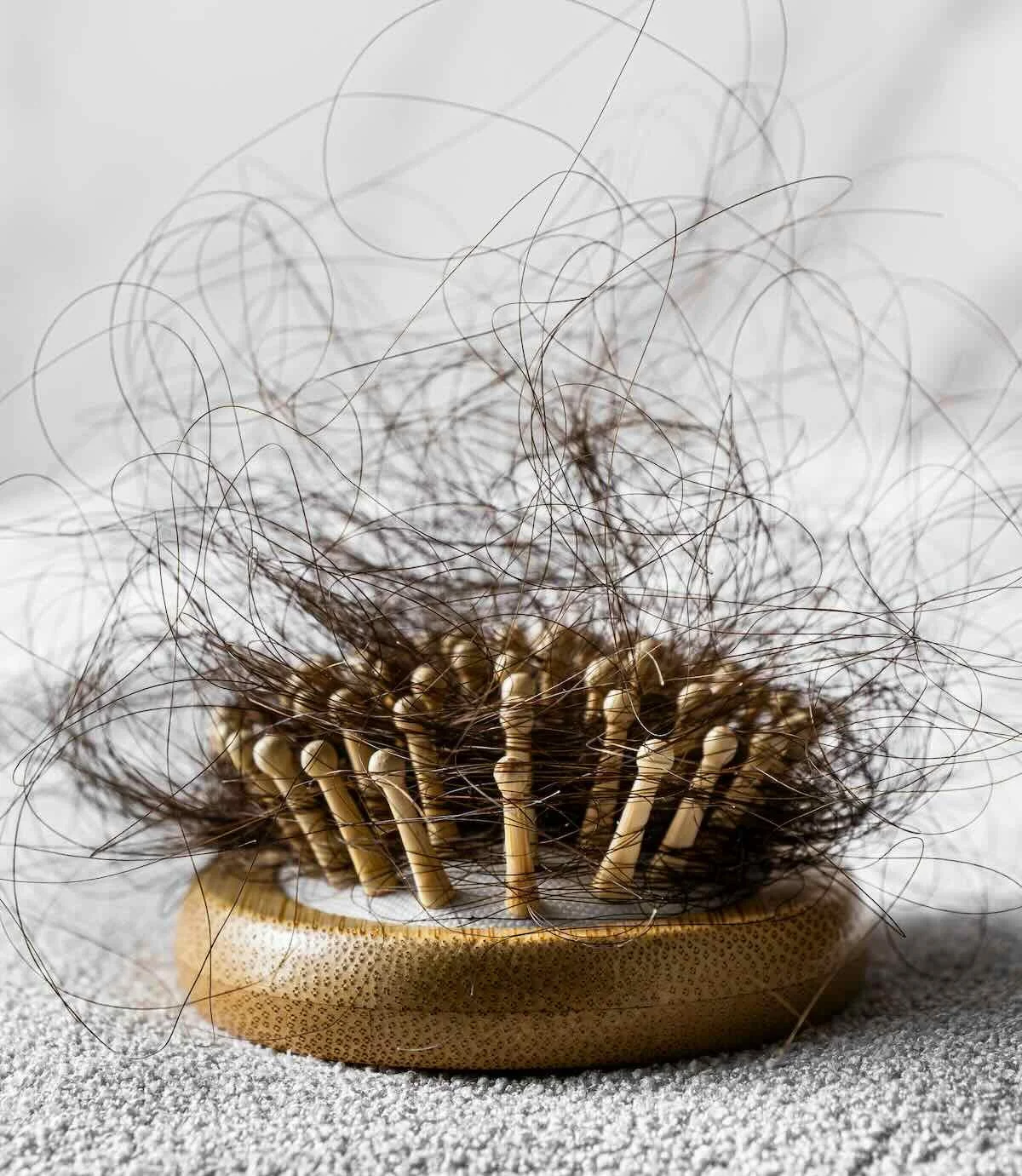
Long strands gather in a brush well before anyone else sees a change.
How Common Is Hair Loss in Women?
Hair loss in women is common, and female pattern hair loss is its most common cause, according to the American Academy of Dermatology. It usually begins in a woman's 40s, 50s, or 60s, and early signs include a wider part and a thinner ponytail. It progresses over time, but women do not lose all their hair, as some men do. A 2001 study of 377 women in the British Journal of Dermatology found female pattern hair loss in 6 percent of women under 50 and in 38 percent of women aged 70 and over.
It is not the only kind. Telogen effluvium is sudden, heavy shedding that starts a few months after a shock to the body, such as illness, childbirth, surgery, or rapid weight loss. Traction alopecia and central centrifugal cicatricial alopecia, or CCCA, can scar the scalp; both are most common in Black women, and the loss is permanent once scarring sets in.
What Does a Colorist Notice First?
A colorist often notices hair loss before anyone else does, because the signs show at the root. The part sits a little wider than it did, more scalp shows under the light, the texture turns drier or coarser, and color takes differently than it did a season before. Someone who sees the same head of hair every six to 12 weeks has a running record of it, which the woman herself, looking in the mirror every day, does not.
Women know this and ask. In a 2018 survey of 118 hairstylists published in SKIN: The Journal of Cutaneous Medicine, two in three said someone had asked them to look at a scalp for hair loss. About half said they refer the person to a dermatologist.
Can a Thyroid Problem Cause Hair Loss?
Yes: thyroid disease can cause hair loss, and thyroid hair loss usually thins the whole head rather than one spot. It is also far more common in women than most people assume. The American Thyroid Association reports that women are five to eight times more likely than men to have thyroid problems, that one woman in eight will develop a thyroid disorder during her lifetime, and that up to 60 percent of people with thyroid disease do not know they have it. A 2013 letter in the International Journal of Trichology by Maya Vincent and Krishnan Yogiraj notes that diffuse hair loss is sometimes the first sign of an underactive thyroid. In a 2013 study of 460 people with an underactive thyroid, mostly women, published in the Indian Journal of Dermatology, doctors found diffuse hair loss in 46 percent and coarse scalp hair in 29 percent.
I have seen it many times over the years: hair that turns dry and changes texture, and color that no longer takes the way it used to. Thinning in one place is different. Patchiness can stem from many stressors, and sorting out which one belongs to a dermatologist. A colorist can notice a change; only a doctor can say whether the thyroid is behind it.
What Are Women Doing About It?
Most women who treat hair loss start with minoxidil, the only FDA-approved hair-loss treatment for women, sold without a prescription. Women's Rogaine 5% Minoxidil Unscented Foam is the best-known form: the brand directs it onto the scalp once a day and says results begin to show in three to six months. The American Academy of Dermatology advises using minoxidil continuously for six to 12 months before judging how well it works, and that the benefit fades once you stop.
A growing number now take minoxidil as a low-dose pill, prescribed off-label. The practice spread after The New York Times reported on it in August 2022: in a survey published in Cutis in 2024, 27 of 65 dermatologists said the article led them to start prescribing it or to prescribe it more. In a randomized trial of 52 women, published in 2020 in the Journal of the American Academy of Dermatology, Paulo Müller Ramos and colleagues found that 1 milligram a day by mouth worked about as well over 24 weeks as a 5 percent solution applied to the scalp. Unwanted facial and body hair was the most common side effect of the pill, reported by 27 percent of the women taking it.
Dermatologists also prescribe other pills off-label, including spironolactone and finasteride, which are not for use in pregnancy. Beyond medication, women are trying lasers, platelet-rich plasma injections and transplants. The evidence for supplements is mixed, and the American Academy of Dermatology says shampoos sold for hair loss cannot regrow hair. Estrogen hasn't helped either: a 2026 systematic review of 13 studies in the Journal of the American Academy of Dermatology found no consistent benefit for hair loss around menopause.
Is It Safe to Keep Coloring Thinning Hair?
No research says a woman losing her hair has to stop coloring it, so the choice is personal and best discussed with her dermatologist. The same question comes up with pregnancy, as in Can You Color Your Hair During Pregnancy? Here's What a Colorist Actually Thinks.
Watch the scalp. Color and lightener sit on the scalp, and minoxidil can irritate it: the American Academy of Dermatology lists dryness, scaling, itching, and redness as common side effects, and 19 percent of the women using the topical solution in the 2020 trial reported an itchy scalp. Some people are more sensitive than others. For a sensitive scalp, the rule of thumb is not to shampoo before a color appointment, because the scalp's natural oil buffers it against coloring products. Tell the colorist about any scalp treatment before applying color.
When Should a Woman See a Dermatologist?
A woman should see a dermatologist at the first sign of hair loss because, as the American Academy of Dermatology puts it, treatment delivers the best results when started early. Time matters most with the scarring kinds, where lost follicles do not come back. In a Northwestern University survey of 34 Black women with CCCA, 15 percent first learned of their hair loss from their stylist, and 47 percent waited a year or more before seeing a doctor.
The brush notices first, then the part, then the person who colors the hair. The dermatologist should not be the last to hear about it.
Photo by Maryam Sicard on Unsplash
Effortless Color For The Real You.