The first week the radiators come on in New York, the scalp notices before the hair does. Fingers drift to the hairline and the part; an itch behind one ear lasts through a whole meeting; and by afternoon, a fine white dust has settled on the shoulders of a black top. Most people call it dandruff. Often it isn't, and the difference determines what helps.
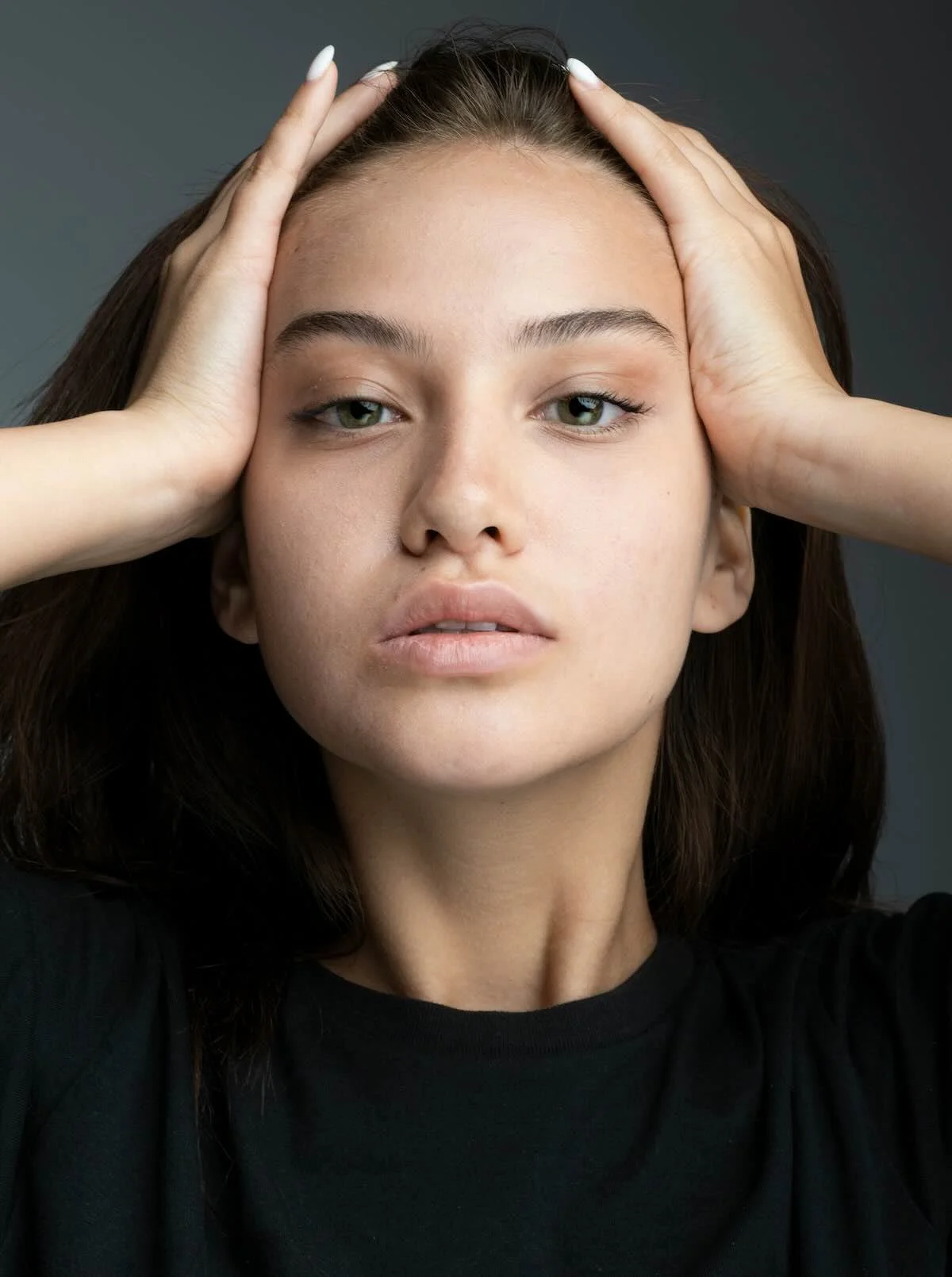
Hands at the hairline, where a winter itch tends to start.
Is It Dandruff or Dry Scalp?
Dry scalp is skin that has lost moisture, while dandruff is a scalp condition involving skin oil, Malassezia yeast, and individual susceptibility. Dryness often produces fine flakes alongside dry skin elsewhere, while dandruff can produce white or yellowish flakes that are oily or dry. Appearance offers clues, not a diagnosis. Board-certified dermatologist Dr. Snehal Amin of MDCS Dermatology describes the usual differences for Marie Claire.
Dandruff also has a medical definition. In a 2015 review in the Journal of Clinical and Investigative Dermatology, Luis Borda and Tongyu Wikramanayake of the University of Miami place dandruff and seborrheic dermatitis on one spectrum. Seborrheic dermatitis is the inflamed form, which can reach other oily areas of the body; dandruff stays on the scalp and itches and flakes without visible inflammation. Skin oil, a yeast called Malassezia, and individual susceptibility all play a part. Dermatologist Dr. Robert Finney explained the mechanism to Marie Claire: the yeast lives on every scalp and feeds on its oil, and in people predisposed to dandruff, it overgrows.
Why Does the Scalp Get Drier in Winter?
The scalp can become drier in winter as cold weather and low indoor humidity weaken the skin's moisture barrier. A 2016 review in the Journal of the European Academy of Dermatology and Venereology by Engebretsen and colleagues concludes that low humidity and low temperatures decrease skin barrier function and make skin more reactive to irritants and allergens. The scalp is skin, and in a city of radiators it spends the season moving between cold street air and dry apartment heat.
Seasonal habits add to it. Dr. Amin names hair products and dry, cold winter weather as causes of dry scalp and notes that shampoos can strip hair of its oils; the same Marie Claire piece warns that over-washing depletes them. The same dry air works on the lengths as well as the root, charging them with static, and Hat Season Starts Now: What It Does to Your Hair and Your Color covers what that does under a wool cap.
Can the Wrong Treatment Make Flaking Worse?
Yes: treating dandruff as dryness, or dryness as dandruff, often fails and can leave the scalp worse off. Adding a rich oil is not a reliable treatment for dandruff. In contrast, the American Academy of Dermatology warns that dandruff-treating ingredients can dry curly and coily hair and advises keeping them on the scalp. So the first step is not a product. Flake size and color can offer clues, but dandruff can also produce dry flakes; persistent or uncertain symptoms warrant a dermatologist's assessment.
How Do You Treat a Dry Scalp in Winter?
A dry scalp may benefit from gentle cleansing and a leave-in formulated to hydrate scalp skin; reducing washing can help when frequent shampooing is contributing to dryness. Board-certified dermatologist Dr. Marisa Garshick, speaking to Marie Claire, points to niacinamide, hyaluronic acid, and glycerin to soothe and hydrate the scalp; hyaluronic acid and glycerin are humectants, ingredients that draw water into the skin.
Living Proof Scalp Care Dry Scalp Treatment is a leave-in built on that idea. The brand says its hyaluronic acid-based formula soothes on contact and keeps the scalp hydrated. At the same time, a vitamin B3-based complex works to balance the scalp’s microbiome, the community of microorganisms living on its surface. Apply it to a clean, damp scalp and massage it in without rinsing three times a week; the brand says you'll see full results after four weeks, and it's safe for color-treated hair. Living Proof also makes it clear it's not an anti-dandruff treatment, which is why it's important to tell the two apart first. A product earns its place by answering the right problem, the principle behind What Earns a Place on the Shelf.
What Works for Dandruff?
Dandruff responds to a medicated shampoo, and the American Academy of Dermatology names the active ingredients to look for: zinc pyrithione, salicylic acid, sulfur, selenium sulfide, ketoconazole, or coal tar. Some need five to ten minutes on the scalp before rinsing, and if one stops working, the academy suggests alternating with a shampoo built on a different active. For coarse, curly, or coily hair, it advises using the dandruff shampoo about once a week and following with the usual shampoo and conditioner for the lengths. When home care doesn't bring relief, dermatologist Dr. Mona Sadeghpour advises seeing a board-certified dermatologist.
Should You Color Your Hair When Your Scalp Is Flaking?
Hair dye should wait if the scalp is irritated or damaged, and unexplained flaking should be discussed before a color application. Color and lightener can contact the scalp, although off-scalp techniques keep the application away from the skin. The U.S. Food and Drug Administration advises against dyeing hair when the scalp is irritated, sunburned, or damaged. Leaving hair unwashed is not a substitute for that precaution. The FDA also recommends a skin test before each use of hair dye, following the product's directions; its hair-dye safety guidance describes checking for a reaction over two days. A skin test does not establish that an irritated scalp is ready for color.
Summer asks the scalp to shed sweat, sunscreen, and buildup; winter asks it to hold on to water. The useful routine starts with understanding the cause, then matching cleansing and treatment to it. Flaking is information to share before color goes on.
Photo by OSPAN ALI on Unsplash
Effortless Color For The Real You.
albertcolor.com