Four Horses, Six Years Later
I was going through old photos a few weeks ago — not looking for anything in particular, which is usually when you find the thing you didn't know you were looking for — and came across four enormous aluminum horses standing at the entrance to Central Park, necks arched into archways, heads bowed nearly to the pavement. I'd forgotten how completely they stopped me the first time. The installation only stood for about a year, from September 2019 to August 2020, and then it came down, and the memory came down with it until the photo resurfaced.
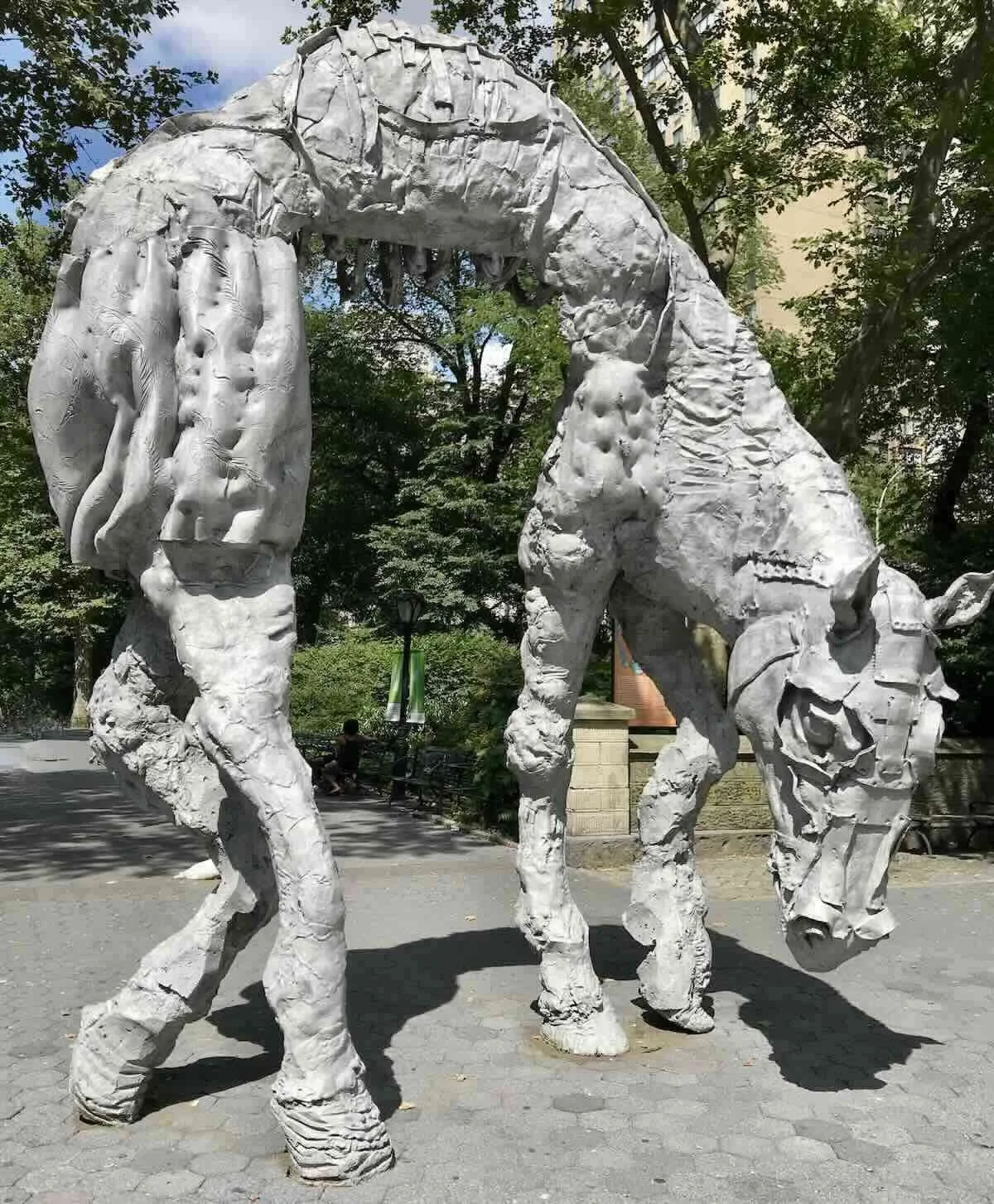
Jean-Marie Appriou's "The Horses," Central Park, 2019–2020.
A Gate Made of Horses
The horses were Jean-Marie Appriou's — a French sculptor who cast them in aluminum from clay and foam models he'd carved by hand, leaving every tool mark and fingerprint sitting right there on the surface. Nothing sanded down. Nothing smoothed over. Up close, one of them looked less like a finished sculpture and more like the moment right before someone decided it was finished — every gouge and ridge from the carving fully visible, catching the light differently depending on where you stood.
Each of the four had its own title and its own logic, once you knew to look for it — one read as a warrior in armor, another as a tangle of legs meant to suggest lovers in a wood, a third settled back onto its haunches like some sphinx. I didn't know any of that when I walked up, whatever month this actually was. I just knew I wanted to stand under it a while longer, which was unusual for me on a corner I usually sped past.
I stood under one of them for longer than I meant to. It was built almost like a gate — you were meant to walk through it, not just look at it from a respectful distance the way you would the general across the street on his pedestal. That alone felt like an argument about something, before I even knew what the argument was.
What Was Actually Being Argued
The general across the street — Saint-Gaudens's monument to William Tecumseh Sherman — is gilded. Gold leaf, idealized posture, elevated on a pedestal specifically so you look up at it. It's a beautiful piece of work, and it's also a very old argument about what a monument is supposed to do: smooth a person into a symbol, polish away anything that looks like effort or doubt, put them somewhere you can't get close to. It's still standing there now, permanent, the way monuments like that are built to be.
Appriou's horses made the opposite argument, for the year they were allowed to. Public Art Fund curator Daniel S. Palmer described them as inviting people through, under, and around the work rather than up at it, and the pieces themselves seemed built to resist the idea that a public sculpture has to be a finished, untouchable thing. The surfaces carried what Palmer called their "hallucinatory qualities" and "dreamlike energy" precisely because the process never got erased — you could still see the carving, the casting seams, the evidence of a hand deciding where to leave things rough.
I didn't expect a pair of long-gone, temporary horses to be still teaching me something six years later, sitting in a folder of old photos. But going back to look at them now, most of what I do involves the same basic decision they were built around: what evidence of the process to leave visible, and what to smooth away entirely.
What This Has to Do With the Chair
Balayage is a hand-painted technique for a reason. Done well, you can still see the logic of the hand that placed it — the sweep, the graduated brightness, the places where a colorist chose to hold back rather than lighten evenly across the whole head. It's the opposite of a uniform, machine-even result, and that's deliberate. The visible hand is the point, just as Appriou's tool marks were the point rather than an oversight.
Gray coverage works on a similar instinct, even though it looks nothing like balayage on the surface. The goal was never to erase what's actually there and replace it with something uniform — it's to work with the silver pattern a client already has, the way it grows in, the way it catches light, rather than covering it over the way gold leaf covers bronze. A gilded, uniform version of gray coverage exists, and it looks like exactly what it is: an erasure. The more interesting work is the version where you can still tell, if you look closely, that this is someone's actual hair doing what it actually does.
I think about this most during a consultation, when a client is deciding how much of their own texture, density, or gray they want visible in the final result, and how much they'd rather have smoothed away entirely. There's no universally correct answer, and it isn't mine to make for them. But I've noticed that the results I'm proudest of, years later, are usually the ones where you can still see a little of the raw material underneath the work — the same reason an old photo of four rough aluminum horses stopped me cold, six years on, while scrolling past a hundred other things I'd actually meant to find.
Effortless Color For The Real You.