The conversation about gray hair has changed. Not gradually, quickly, visibly, and in the last few years, in ways that are impossible to miss if you spend your days behind a color chair. Women who once came in asking to cover every gray are now asking something different: what if we work with it instead? That’s a different focus and a different mindset.
That shift has created both clarity and confusion. Now there are options — real ones, with different techniques, timelines, costs, and very different expectations. And the terminology has not kept up with reality.
Two terms come up most often in my consultations: Gray blending and French blending. Clients use them interchangeably. They are not the same thing.
The difference matters — specifically, what each approach costs, how long it takes, and what you should know before you choose.
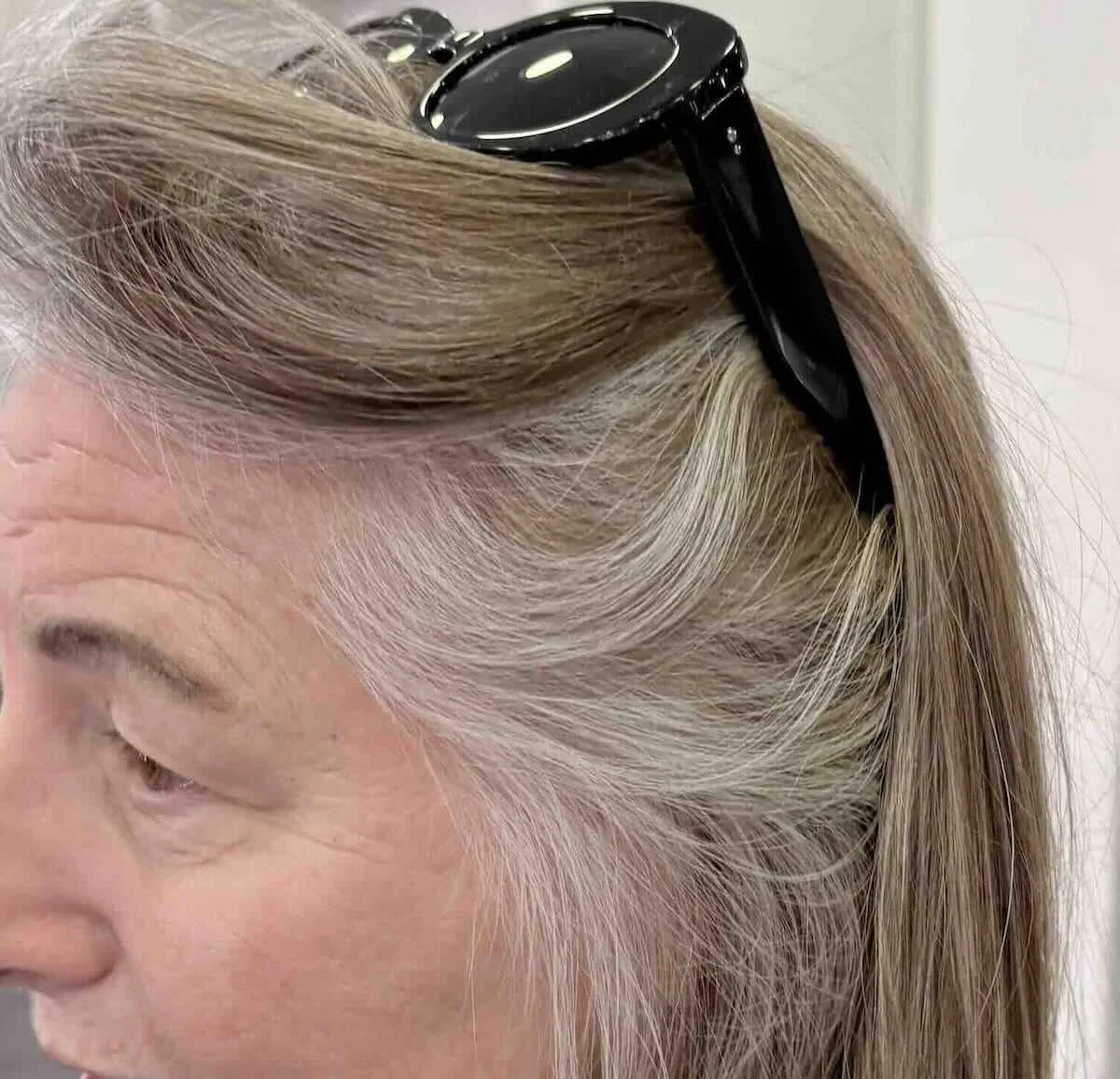
Gray blending in practice — warm dimension woven through natural gray. Nothing that announces itself as color.
What Gray Blending Actually Means
Gray blending is not a single technique. It is a category — an umbrella term for any approach that integrates gray hair into the overall color result rather than completely covering it.
As reported by Paris Select Book, gray blending is essentially a transitional balayage: the colorist blends white highlights into the base color strand by strand, using light or dark highlights, tone-on-tone gloss, and cool shades to erase the root effect by integrating white regrowth into the final result. The goal is not to eliminate the gray. The goal is to make it look intentional.
Under that umbrella, the methods vary widely:
Balayage for gray — hand-painted highlights that soften the contrast between colored hair and natural gray growth. Low-maintenance by design. The grow-out is part of the result.
Foil highlights — more structured, more precise. Used to build dimension and soften the gray pattern, particularly at the hairline and crown, where gray tends to concentrate.
Gloss and toning — used to neutralize brassiness and unify tone across gray and colored sections, and often added to any of the above.
Full gray transition — a multi-visit process over several months that gradually shifts the hair from color-dependent to fully natural. The transition is managed, so the grow-out line never looks abrupt. It is not the right route for every head of hair, and cases where gray blending is the wrong call tend to show early.
The beginning stages of growing out your hair to fully transition to gray can feel awkward. Oftentimes, there’s a harsh root line to begin with, and not everyone has a consistent gray pattern—but there is one super helpful solution: gray blending. Gray Blending is the most flattering way to transition to natural silver, says celebrity colorist and hair color educator Amelia Fugitt. —Parade
The cost of gray blending varies significantly by technique, stylist, location, and hair history. In my Midtown Manhattan practice, gray blending—depending on technique and complexity—typically ranges from $300 to $600 per session, with maintenance visits spaced every 10 to 14 weeks. Those figures reflect New York pricing and my own client base, not a single universal standard; cost and maintenance rhythm vary by market and salon. Anyone weighing that rhythm against stopping color altogether is really asking a different question: what the grow-out itself looks like month to month.
For clients managing brassiness at home between appointments, Kérastase Blond Absolu Bain Ultra-Violet neutralizes yellow tones on cool blonde and gray-blended hair without disrupting the dimension built in the salon.
What French Blending Is — and Who Owns the Term
French Blending™ is a trademarked service developed by L'Oréal Professionnel. That matters because it is not simply a style or a philosophy — it is a specific, proprietary system with defined application techniques, color formulas, and protocols. Paris Select Book
French Blending™ pairs innovative, unique color formulas with a Vertical Weaving Technique to blend grays rather than cover them, creating a custom service with multidimensional results. — L'Oréal Professionnel
As covered by AOL, French blending has become associated with a certain kind of intentional elegance — most visibly through clients like Andie MacDowell and Meryl Streep, who have made natural gray part of their public identity rather than something to be managed away. The approach disperses tone softly throughout the lengths rather than concentrating coverage at the root, which gives it a finish that reads as considered rather than corrected. Where gray blending integrates existing gray into the color result, French blending works more by diffusing tone throughout — a different priority, and a different outcome.
The technique is bespoke by design. L'Oréal Professionnel developed French Blending™ in three stages: First Blending for clients experiencing their first grays, Retouch Blending for maintaining an established blend, and Total Blending for a full-head, more comprehensive transformation, with progressively more complex formulations as gray density increases.
French Blending™ is a salon-only service, available exclusively through trained L'Oréal Professionnel colorists. It cannot be replicated at home or approximated by a colorist who has not been trained in the system. Paris Select Book
The Time Conversation
This is where the difference between the two approaches becomes most concrete — and where I see the most misaligned expectations in my consultations.
Gray blending, depending on the technique, typically takes 2 to 4 hours per session. Balayage-based approaches sit on the shorter end. More complex foil work, especially on long or dense hair, can take longer. The maintenance interval is generous: most gray blending clients return every 10 to 14 weeks, sometimes longer. The grow-out is built into the result.
French Blending™ is a different conversation. L'Oréal Professionnel describes the personalized service as taking one to six hours, depending on the client's gray density, hair length, and color history. With complex cases — significant gray density combined with a long color history — the initial diagnostic-and-application appointment can run toward the longer end of that range, and some clients choose to split the work across two sessions rather than complete it in one sitting.
This is not a lunch appointment. It is a commitment — and it should be treated as one.
Maintenance after the initial service is more manageable. While the initial appointment may take longer and cost more, the results last longer and require fewer salon visits, ultimately saving time and money in the long run. Ongoing French Blending™ appointments typically run 3 to 4 hours and are spaced 12 to 16 weeks apart.
The Cost Conversation Nobody Wants to Have
Let me be direct here, because this is the question I am asked most often and the one most likely to go unanswered until the client is already in the chair.
Gray blending — depending on technique and complexity — ranges from $300 to $600 in my Midtown Manhattan practice. A gloss-only service sits at the lower end. A full balayage session with toning sits higher. A complex multi-foil service on long, dense hair with significant color history is at the top of that range or beyond. These numbers reflect New York pricing specifically; other markets can run meaningfully lower.
A complete color correction — which some gray transition clients require as a starting point — can run $1,000 or more, as it requires a skilled stylist, significant time, and product volume. That is not a gray blending appointment. That is a reset.
French Blending™ is priced differently — and significantly higher for the initial service. In a New York salon offering the full L'Oréal Professionnel protocol, the initial French Blending™ appointment — accounting for the consultation, formulation, multi-stage application, and finishing — typically starts at $800 and can reach $1,500 or more for long, dense hair with complex gray patterns. Some salons charge a day rate.
That number is not arbitrary. It reflects the training required to deliver the service correctly, the proprietary color system it uses, and the time it demands. A discounted French Blending™ service is not French Blending™.
Ongoing maintenance appointments, once the initial transformation is complete, are substantially less — typically $400 to $700 per visit, spaced further apart than traditional color services.
The honest comparison: Gray blending is a lower-entry-point option with consistent, moderate maintenance costs over time. French Blending™ has a higher entry point and a lower long-term frequency. Neither is inexpensive. Both are investments. The question is which investment structure fits your life.
Which One Is Right for You
The answer depends on three things: your gray pattern, your timeline, and your budget.
If you are early in the gray transition — 20 to 40 percent gray — gray blending is almost always the right starting point. It is flexible, iterative, and grows with you. The commitment is manageable, and you can adjust the results at every appointment as the gray pattern evolves.
A threshold of around 30 percent gray is often recommended to achieve a natural blend. Enough to ensure a smooth transition with no sharp break between color and regrowth, and Paris Select Book notes that at least 4cm of visible regrowth is typically needed for the technique to work well.
If you have significant gray density — 50 percent or more — and you want a complete transformation in a defined timeframe, French Blending™ may be the right conversation. But go in with eyes open about the time and cost involved.
If you are transitioning away from full-color coverage — stopping a long-term coloring regimen and moving toward your natural gray — the process takes time, regardless of the technique you use. No shortcut looks good. The transition is managed over multiple visits, typically spanning 4 to 6 months.
Olaplex Nº.0 Intensive Bond Building Treatment is among the most evidence-backed at-home options for strengthening chemically processed hair between appointments — applied to dry hair and left on for ten minutes, not as a daily product, but as a weekly ritual. Use it once a week before shampooing to repair bond damage that accumulates during the transition process — keeping the hair strong enough to handle what comes next. What comes next is a sequence rather than a single appointment, and deciding to go gray is the step that precedes it all.
The pattern shown above — silver-white at the temples, ash-blonde through the length — is what we're designing around, not covering. That distinction is the whole point of gray blending: working with what's actually there, not against it.
The only approach worth having is the one that works with your hair — and your life. That is what I design for.
Effortless Color For The Real You.