Temporary Hair Color for Halloween: When One Night Doesn’t Wash Out
The witch in the garden chair has green hair down to her waist, a wide grin painted across a white mask, and a cauldron of candy in her lap. The green ends where the hat begins. It is a wig, and whatever hair sits underneath will go home the color it arrived. That is the one Halloween color guaranteed to come off. Everything sprayed, chalked, or combed onto real hair makes a promise it cannot always keep.
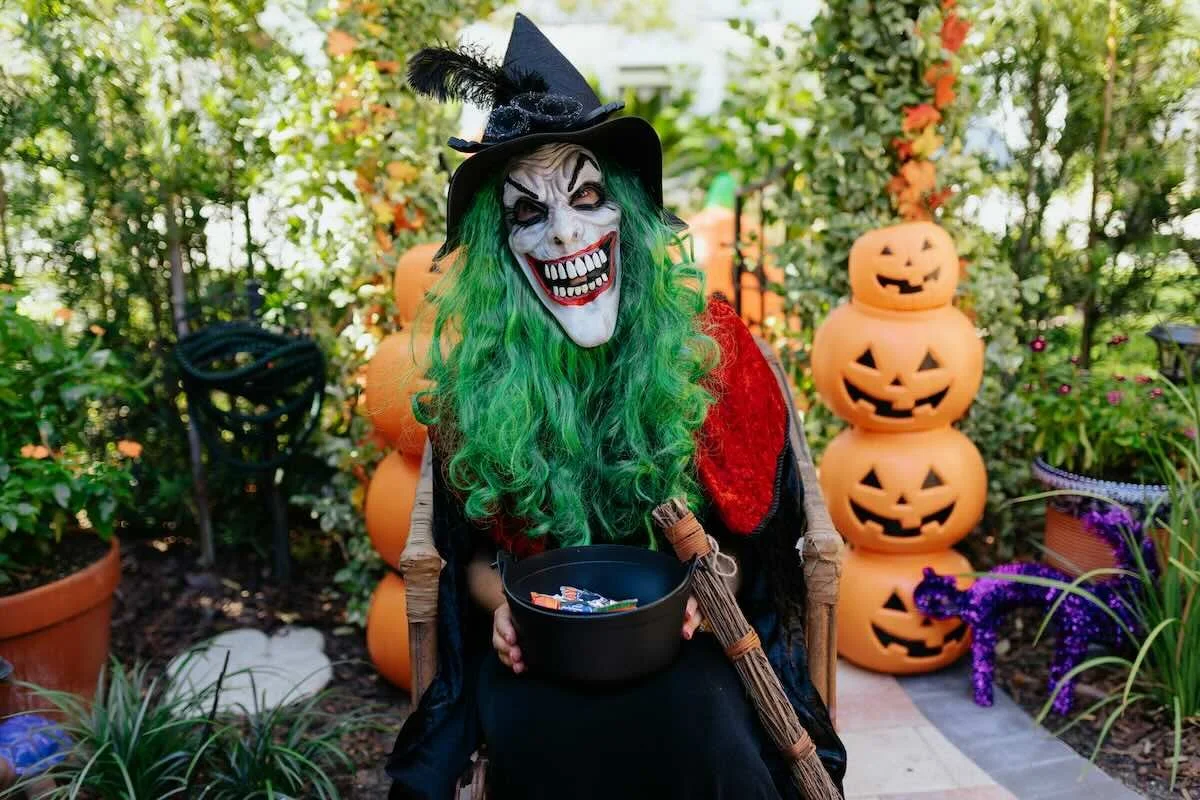
A green wig under a witch’s hat, the one Halloween color guaranteed to go home at the end of the night.
What Does Temporary Hair Color Actually Mean?
Temporary hair color sits on the hair's surface and is designed to rinse out with the first shampoo. A 2015 review of hair dye chemistry in the journal Cosmetics by França and colleagues describes temporary dyes as large molecules that deposit on the cuticle without reaching the cortex and dissolve readily in water, so the first wash removes them. The cuticle is the hair’s outer layer of overlapping scales; the cortex is the core beneath it, where natural pigment lives.
Sprays, chalks, gels, and colored waxes all work this way. They are makeup for hair: color laid on the surface, not color put into the strand. The formula is built for one night. What decides whether it keeps that promise is the hair underneath.
Why Does Temporary Color Last Longer on Blonde, Highlighted or Bleached Hair?
Temporary color lasts longer on lightened hair because bleaching leaves the fiber more porous and more negatively charged, so pigment meant to sit on the surface gets in and holds. The Cosmetics review puts a number on it: on bleached hair, a temporary dye resists three to six washes, the same range it gives for semi-permanent color. Maria Fernanda Gavazzoni Dias, writing in the International Journal of Trichology in 2015, describes bleached and chemically treated hair as more porous than virgin hair, with a higher concentration of negative sites, and more rapidly penetrated by dyes.
What a lightener does inside a strand, down to the bonds it breaks, is the subject of Bond Builders, Explained: What Actually Repairs Hair and What Only Feels Like It. The short version for Halloween: highlights, balayage and a summer of grown-out platinum are exactly the hair most likely to carry a costume color into November.
Tone matters as much as porosity. Manic Panic, the New York color brand, warns in its own guidance that blue over a yellow-toned blonde can veer teal or green, and that the whiter the hair, the truer the shade. White and gray hair show temporary color more vividly; the same review notes that on white, blond, or bleached hair, a new color shows more noticeably because no natural pigment sits underneath to mute it. A green that reads as a tint on brown hair reads as green on silver. Gray Hair: The Whole Conversation explains how hair changes once it stops making pigment.
Is Semi-Permanent Hair Color Really Temporary?
Semi-permanent color isn't temporary in the Halloween sense: it is designed to go inside the hair, whereas a spray is meant to stay on the surface. The Cosmetics review describes semi-permanent dyes as small, positively charged molecules that slip slightly into the cortex and bind to the fiber's negative sites. In its words, these dyes “exhibit excellent affinity for damaged hair.” Bleached hair, with more of those negative sites, is damaged hair in exactly the sense that matters.
The labels blur the line. Wash-out, temporary, semi-permanent, and color-depositing can sit side by side on one shelf, and a costume that calls for one night of color is a reason to read which one is in the box. A product made to last isn't a one-night product, no matter what the packaging says.
How Do You Wear Halloween Hair Color for One Night?
The safest one-night color never touches the hair at all; after that, it is a spray tested first and washed out before bed. A wig guarantees the hair goes home unchanged. For color on real hair, Manic Panic’s guidance for its temporary sprays is short: shake the can well, spray from at least 12 inches away in short bursts, cover anything nearby that could stain, and remove the color before it rubs off on bed linens.
Manic Panic Ultra Violet Temporary Color Spray is the kind of product a costume calls for. The brand says it washes out with shampoo and shows on dark and light hair, and its violet sits naturally beside a witch’s black. On lightened hair, a strand test on a hidden section a few days ahead answers the question before the party does.
One safety line belongs in the plan. Manic Panic says its aerosol cans are flammable and should be kept away from heat, and on Halloween, that includes the candle inside the pumpkin.
What If the Temporary Color Doesn’t Wash Out?
If a temporary color remains after several shampoos, the answer is patience and a clarifying shampoo, not a lightener. A clarifying shampoo is a deep-cleaning formula that strips buildup and residue, and the brand says Manic Panic Prepare to Dye Clarifying Shampoo can gradually fade its own color.
Reaching for bleach to lift a stubborn green out of blonde hair trades a stain for damage. The lightening that made the hair hold the color in the first place is what breaks it down, and a second round lands on hair that has already been through the first. A color stain on lightened hair is a correction, and a correction is a colorist’s work: what removes it depends on the pigment, how far it went in, and how much more the hair can take.
Halloween is the one night of the year when hair is costume, and a costume is meant to come off. The witch in the garden had the right idea: her green was never in her hair to begin with.
Photo by Ivana Cajina on Unsplash
Effortless Color For The Real You.
albertcolor.com