Gray Hair: The Whole Conversation
At a certain point, the part line stops being a place you comb and starts being a place you check. Silver arrives there first, and it arrives without asking. The same head of hair can read two entirely different ways depending on one decision, and neither reading is more honest than the other.
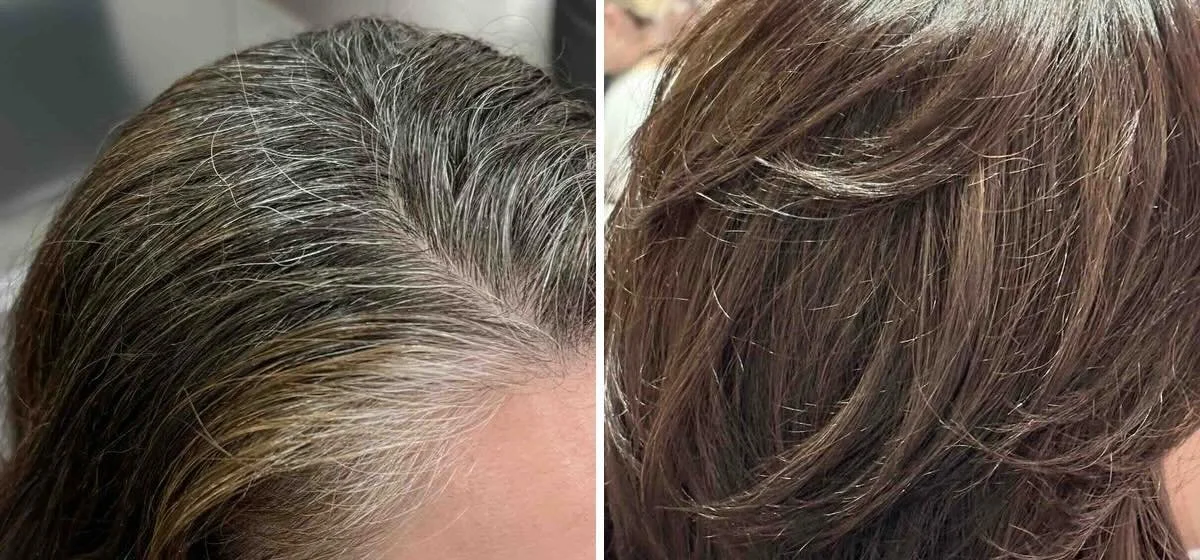
The part line is where silver announces itself first, and where the decision gets made.
Where Gray Actually Comes From
Hair color is decided before the strand ever leaves the scalp. Pigment cells sit in the follicle; they load color into the hair while it is being made, and once that strand exists, its color is finished. Brown hair does not slowly turn silver. It stays brown for as long as it lives, sheds on schedule, and the follicle grows a replacement with less pigment in it than the one before.
That distinction matters more than it sounds. Nothing on your head is changing color right now. What is changing is the factory, one follicle at a time, and the result only becomes visible once enough replacements have grown in to shift what you see at the part. It explains why gray seems to arrive suddenly when it has in fact been arriving for years.
The timing is mostly inherited. Vogue went looking for where gray comes from and landed on what dermatology has long known: the honest predictor is not your stress level; it is your parents and the generation before them. If you want to know when you will go gray, the family photographs are better evidence than anything happening in your life this year.
What Stress Does, and What It Does Not
The stress story is not entirely wrong. It targets the wrong mechanism.
Stress cannot reach into a strand that already exists and drain it. What it can do is speed up shedding, meaning follicles cycle sooner than they otherwise would, and the next generation of hair arrives earlier than it was due. If those replacements come in with less pigment, you meet that fact ahead of schedule. Stress does not turn hair gray. It brings the date forward.
A few other things sit in the same category. Thyroid conditions, some autoimmune conditions, certain nutritional deficiencies, and smoking all appear in the research as contributors. None of them is why most people go gray, and none is worth self-diagnosing from a blog. If gray arrives strikingly early, or alongside anything else that has changed, that is a conversation for a doctor rather than a colorist.
How Soon, How Late
The range is wider than people expect. Some find the first ones in their twenties. Some reach fifty with barely any. The average sits somewhere in the thirties, and the average describes almost nobody.
What matters more than the percentage is the pattern. Gray does not distribute itself evenly. It concentrates, and where it concentrates decides how visible it is long before it decides how much of it there is. Twenty percent gathered at the hairline reads as far more than forty percent scattered through the back. Two people with the same amount of silver can have completely different experiences of it, which is why a percentage is a poor way to decide anything.
Texture changes the reading too. Unpigmented hair is often coarser and more porous than the hair it replaced, so it catches light differently and sits differently in a style. Some of what people describe as their hair going wiry is really their hair going gray.
What People Actually Do About It
There are three honest routes, and the decision itself is worth making properly.
The first is coverage. It is a real choice rather than a failure of nerve, and plenty of people make it with clear eyes for decades. It asks for consistency, and that consistency is the whole deal.
The second is blending, which lets the silver already there become part of the design instead of something being corrected each time. It suits some heads and not others, and knowing which you are is more useful than wanting to be one.
The third is letting it come, which takes the most patience, because the middle is genuinely awkward and there is no way to shorten that stretch by wanting it shorter.
Whichever route you choose, upkeep is where people are most often surprised. Silver is not a color you apply once and leave; it is a tone that drifts, and the drift is faster on hair that has lost its pigment because there is nothing underneath holding it steady. Most of the maintenance mistakes I see are corrections to corrections, and almost all of them stem from reaching for a purple bottle more often than the hair asked for.
Most people I sit with are somewhere between routes rather than committed to one, and that is a reasonable place to be. A decision does not have to be final to be deliberate. It has to be made on purpose, with the variables understood, and then it is allowed to evolve.
What Is Actually Changing
The part of this conversation that has moved most in the last decade is not the chemistry. It is the permission.
Gray used to be something managed quietly, on a schedule nobody discussed out loud. That has loosened. More people are letting it come in on purpose, more are asking for it to be designed rather than concealed, and the word that comes up now is direction rather than disguise. Some of that is fashion and will move again. Most of it will not.
The language moved before the practice did. Nobody says covering the gray the way they did fifteen years ago; they say growing it out, going silver, or leaving it. That shift in wording is not cosmetic. It changes gray from a problem with a maintenance schedule into a stage with a design, and a stage can be planned for in a way a problem cannot.
What has not changed is that it should be a decision. The worst version of gray is not gray at all. It is gray that happened to someone who was not paying attention, growing out against a color chosen years ago for a person they have since stopped being.
The rest of what I have written about gray sits underneath this: the middle months, who blending suits, coverage as a legitimate choice, and the moment it stops being a problem to solve.
Cut by Elvin Arvelo.
Effortless Color For The Real You.
albertcolor.com