Gray Blending on Dark Hair: Why Your Natural Color Changes the Plan
Against near-black hair, a single white strand catches the light like a thread on a dark coat. On lighter hair, the same strand would barely register. That distance between the white and the color around it decides how gray blending works on dark hair, and why dark hair asks for a different plan.
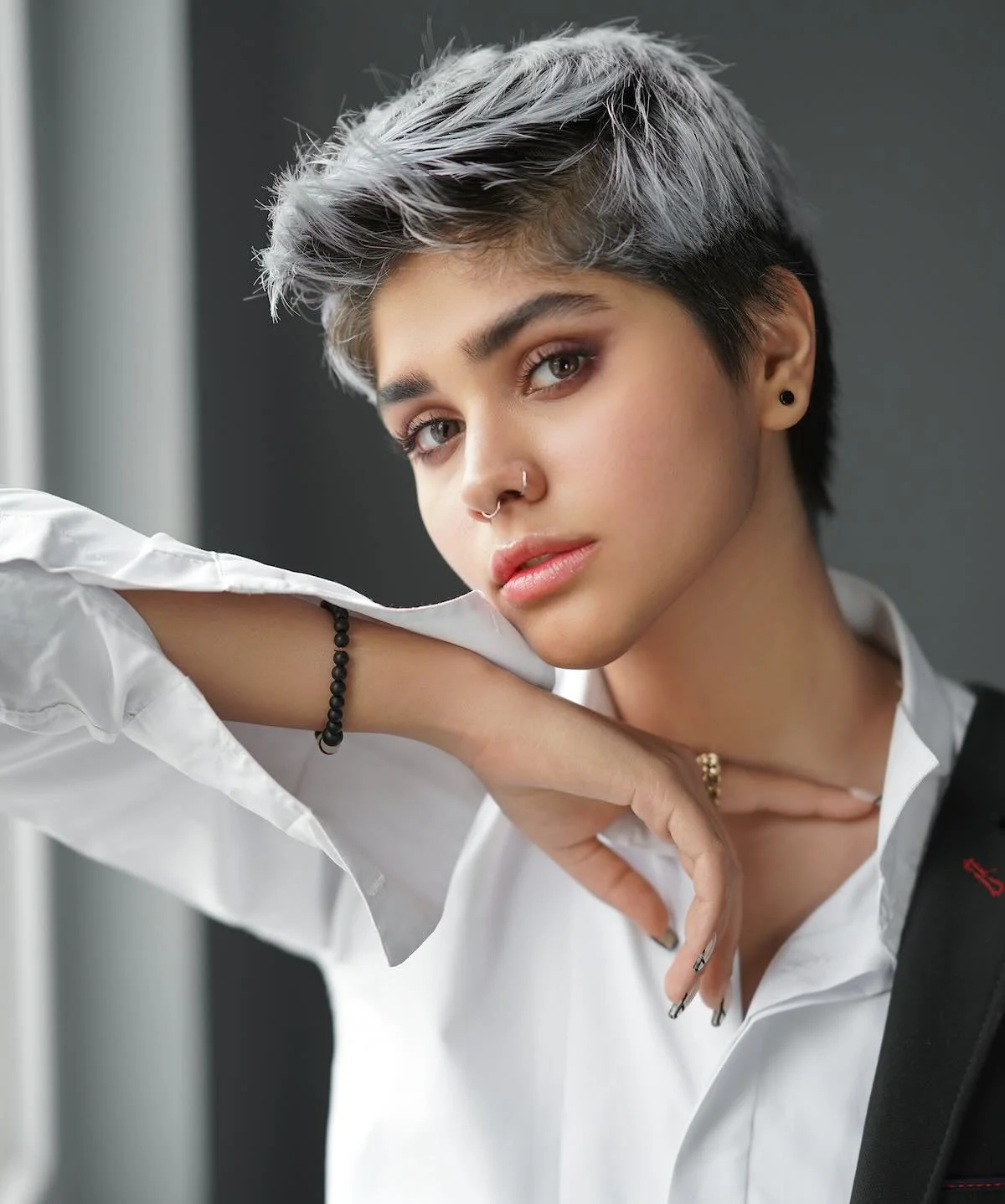
Silver swept over near-black, the contrast that decides how gray blending works on dark hair.
Why Does Gray Show More on Dark Hair?
Gray shows more on dark hair because the contrast between white strands and deep natural color is at its highest. Gray hair is not a single color growing in. It is a mix: white hairs that no longer carry pigment, sitting among hairs that still do, and the eye reads the blend as gray. The darker the pigmented hair around the white, the louder each white strand looks, and the sharper the line where regrowth meets color. Gray Hair: The Whole Conversation traces where that white comes from. On dark hair, the question that follows is what to do about the contrast.
Contrast is also why the same amount of gray reads so differently from one head to the next. A scattering of white through light brown hair looks like highlights. The same scattering through black hair reads as gray at a glance.
Can You Do Gray Blending on Dark Hair?
Yes: gray blending works on dark hair, but the idea is to narrow the gap between the dark and the white rather than to hide the white. As What Gray Blending Actually Means — and Why the Term Gets Misunderstood explains, gray blending reduces contrast so regrowth comes in softly instead of as a line. On dark hair, you have two directions. One is to bring some of the dark hair up, with fine highlights or babylights placed so the white has lighter company. The other is to bring the white down, with a translucent tone that softens it toward the surrounding color without coating it solid.
Which side leads depends on how much white there is and how dark the rest of the hair is. With a little white in very dark hair, softening the white often leads to a better outcome than lightening. When hair is mostly white, the logic reverses: more tonal options are available to create a lowlight, which adds depth so it reads as dimension rather than a solid sheet. Either way, the lighter the remaining natural hair, the easier the blend.
Why Does Dark Hair Turn Brassy When It Is Lightened?
Dark hair turns brassy when it is lightened because lightening exposes warm pigment that was there all along, and that warmth comes mostly from the dark hair, not from the gray. The yellow, orange, and copper tones that appear after lightening generally come from the naturally pigmented hair left in the mix; the darker the hair, the more warmth there is to expose, and the more of it returns as brass over time.
That is why lightening dark hair for a blend is a question of going far enough. The hair educator Adrienne Dara, speaking to PureWow in March 2025, put it plainly: “You must lift enough so that you have a cool canvas to tone and color-match properly.”
Dark hair may not suit this process. In some cases, the hair needs many levels of lift. A level is one step on the colorist’s scale of lightness, from black at the bottom to the palest blonde at the top. Breakage may happen before the underlying warmth is removed. Adding a bond builder to the lightener can protect the hair fiber during this process, and better lighteners include bond builders already in the product itself. What a bond builder actually does, and what it only seems to do, is laid out in Bond Builders, Explained: What Actually Repairs Hair and What Only Feels Like It.
What that warmth is asking for once it appears, and when purple or blue products actually help, is the subject of Purple, Blue, or a Gloss: What Brassy Hair Is Actually Asking For.
Can You Blend Gray on Dark Hair Without Bleach?
Yes: demi-permanent color can blend white strands into dark hair without bleach, because it works on the white and leaves the dark hair as it is. Demi-permanent color deposits tone and fades gradually over weeks without lightening the hair beneath it. On white strands, it reads as a soft veil of the surrounding shade rather than as solid coverage.
Demi-permanent color works well on very dark hair with white. It narrows the contrast without lifting anything, so there is no exposed warmth to manage.
How Long Does Gray Blending Last on Dark Hair?
Gray blending on dark hair grows out more gracefully than solid coverage because there is no hard line at the root, but the tone on top needs refreshing after about eight weeks. After roughly eight weeks, any artificial color becomes unstable, and on dark hair that is usually when the warmth in lightened pieces begins to show again. The blend ages gently. The tone is what asks for attention.
A good plan also starts from a true read of the natural color. Six to eight weeks of regrowth shows what the dark hair and the white are actually doing at the root, rather than what old color suggests they are doing.
What Hair Color Blends Best With Gray on Dark Hair?
Neutral tones blend best with gray on dark hair: beige, taupe, and toast sit between the dark and the white without pulling warm. Neutral shades work with any skin tone. Yellow-leaning shades do the opposite and can leave the skin looking washed out.
Is Gray Blending Worth It on Dark Hair?
Gray blending on dark hair is worth it for anyone who wants the white to arrive as part of their color, not as a line to fight every few weeks. Dark hair makes gray more visible, but it also gives a blend more to work with: depth, shine, and a frame for silver that lighter hair cannot offer. The thread on the dark coat does not have to be pulled out. It can be woven in.
Photo by behrouz sasani on Unsplash
Effortless Color For The Real You.
albertcolor.com